This site uses non-intrusive cookies to enable us to provide a better user experience for our visitors. No personal information is collected or stored from these cookies. The Society's policy is fully explained here. By continuing to use this site you are agreeing to the use of cookies.
BackTrack which is edited by LMS Society Member, Mike Blakemore and which contains items of LMS interest in each issue now has its own web-site where details of the current and past issues can be found.
An index of LMS related articles in volumes 1 to 28 of Backtrack can be found here.
There is also an independent web-site which publishes an index for BackTrack.
MIDLAND TIMES is a three-times yearly 80 page paperback covering the LMS, the pre-grouping constituent companies and their successors the London Midland Region. Each issue is packed with historic images and articles featuring both steam and other forms of motive power together with stations, depots and rolling stock, all illustrated in colour and black and white, wherever possible using previously unseen views.
Details can be found on the Transport Treasury web-site.
This publication which was edited by the late Bob Essery, an LMS Society Founder Member, looked at all aspects of the LMS in both prototype and model. Details of all issues can be found on its LMS Society hosted web-site.
Following Bob's death in November 2021 the publishers have discontinued the title.
Publication of the LMS Journal which was also edited by the late Bob Essery, an LMS Society Founder Member, ceased with Issue 38. Details of all issues can be found on its LMS Society hosted web-site.
There are of course other periodicals which regularly carry LMS related content. Their respective editors are more than welcome to forward details of such via the Hon. Secretary for publication on this page.
While the Society is happy to list any book with LMS content here, such a listing cannot be construed as an endorsement of any book by the Society. Where the author is member of the Society they are identified as such.
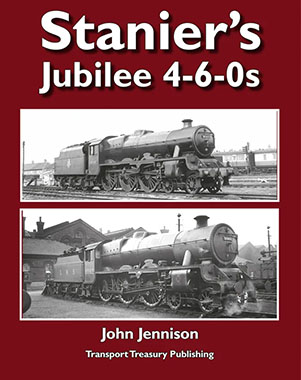
John Jennison - an LMS Society Member.
|
ISBN 978 1 913893 39 2 Transport Treasury 2023. 112 pages. Stanier, poached from the GWR, created a new class of 4-6-0s to form a secondary, 'stiffening spine' of locomotive power behind the Pacifics and Royal Scots. The 191 Jubilee's became ubiquitous across the system and were popular on many routes which didn't have the benefits of the more powerful locomotives - the lines out of St. Pancras, into Scotland on the former G&SW lines, on the Central Division and even down to Bristol are all covered in this album combined with informative and detailed captions. |
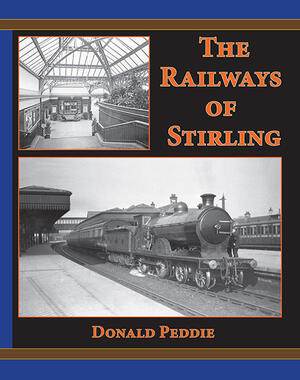
Donald Peddie
|
ISBN 978 1 915069 29 0 Lightmoor Press 2023. 144 pages The ancient burgh - now city - of Stirling has been an important point on transport routes for centuries. Here was the lowest point on the River Forth which could be crossed by a bridge. It was also on the route north to Perth and the Highlands. The main railway to the north was completed in the late 1840s and Stirling was naturally on its route. It became a junction with the construction of the line from Dunfermline in the east and that to Balloch in the west. After the amalgamations of the mid-1860s, the main owner was the Caledonian Railway which ran the main line north and south, with the North British Railway operating the two branch lines. Later, the Caledonian-operated line to Oban increased the traffic. Successive improvements in the layout and facilities at the station resulted in the handsome building and station interior which we see today. Large goods yards were provided both for the extensive local industry and for the interchange of traffic. Locomotive sheds were operated by both companies and these housed an eclectic mix of older and newer engines. Today the station retains its importance in the ScotRail network and has been upgraded to meet modern traffic requirements. The late Donald Peddie spent many years assembling information for this book using his expert local knowledge and thorough research of local and national archives. All aspects of the history of the station and the surrounding facilities are covered. It is a fitting tribute to his memory. |
|
David Pendleton
|
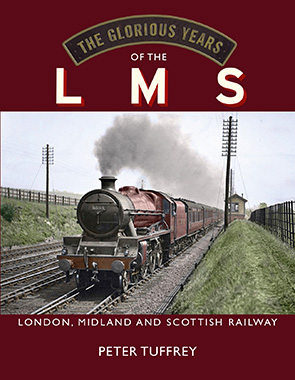
ISBN 978-1-914227-55-4 Great Northern Books 2023. 176 pages. One hundred years have passed from the formation of the largest British railway company - the London Midland & Scottish Railway. This was also the biggest transport concern in the world at the time. The LMSR was able to serve passengers and customers to a high standard up to the Second World War. During the conflict the LMSR made a valuable contribution to the war effort in terms of motive power provision, movement of goods and war materials. The Glorious Years of the LMS examines the company over the period 1923-1947 using over 250 high-quality black-and-white images. These are split into several sections: locomotives; carriages; war work; road vehicles; stations. The LMSR's territory spread across much of England, Scotland and into Wales and the photographs have been taken at a number of locations. These include stations, lineside, sheds and workshops. Several companies constituted the LMSR, including the London & North Western Railway, Midland Railway, Caledonian Railway, Glasgow & South Western Railway, etc. Locomotives from these are included in the collection, alongside those of Sir Henry Fowler - Royal Scot 4-6-0, 4P 4-4-0, etc. - and Sir William Stanier. The latter's designs are most associated with the LMSR and include Jubilee 4-6-0, Class 5 4-6-0, 8F 2-8-0, Princess Royal and Coronation Class Pacifics. The LMSR was an early pioneer of steel-panelled coaching stock and also experimented with different types of carriages - cocktail bar, club car, lounge. Luxurious sets were built for the Royal Scot and Coronation Scot named trains, whilst the company provided new Royal Train saloons in the early 1940s. At the time of Grouping, road transport was increasing and the LMSR was keen to keep the competition at bay. A fleet of nearly 30,000 vehicles was developed, ranging from horsedrawn drays to vans, lorries and specialised trucks, particularly for containerised traffic. The LMSR also branched into bus services. The LMSR existed for just 25 years and during that time the company, the officers and employees were able to create a lasting legacy of hard work, achievement and innovation. |
Peter Tuffrey
|
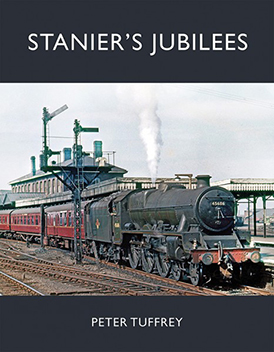
ISBN 978-1-914227-53-0 Great Northern Books 2023. 160 pages Sir William A. Stanier's 'Jubilee' 5XP 4-6-0 Class served as the backbone of passenger services for the London Midland & Scottish Railway - as well as the successor London Midland Region of British Railways - for a number of years. Despite initial design flaws, the class went on to be well-liked by enginemen and enthusiasts alike. Stanier's Jubilees follows the career of this 191-locomotive class from their introduction in 1934 to withdrawal in 1967. A number are featured during the LMSR period, whilst many are seen during the British Railways years. The engines are featured in over 200 excellent colour and black-and-white images. A wide area was worked by the Jubilee Class, ranging from the West Coast Main Line to the Midland Main Line, Glasgow-Perth-Aberdeen route and cross-country from York to Liverpool, in addition to Leeds-Bristol. The images included have been taken at stations, sheds, lineside and workshops. Accompanying the pictures are informative captions detailing the locomotive's history, as well as other interesting details. Four locomotives were preserved following withdrawal at the end of steam and three are in steam at present. Hopefully, they will continue to be so and honour their fallen class mates, many of which are remembered here in this collection. |
|
David Pendleton
Photography by Gavin Morrison
|
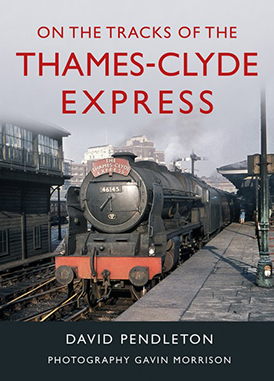
ISBN 978-1-914227-47-9 Great Northern Books. 128 pages. There was nothing quite like the Thames-Clyde Express. Covering well over 400 miles, its route stretched from the dreaming spires of London's St Pancras via the Shires of England, the legendary Settle-Carlisle line, Walter Scott's Border Country and finally into Glasgow - the Second City of the Empire. It never offered the quickest journey between England and Scotland, but it was undoubtedly the most scenic. David Pendleton, a former signalman at several locations along the route of the Thames-Clyde Express, has written what he terms 'a love letter' to this famous named train. Rather than a text ending on the sad day in 1975 when the last train reached its destination, he instead views its history and the tracks it traversed from a present-day perspective. Here is a rich mix of anecdotes and observations, including attractions and oddities either visible from today's train services or within easy reach of principal stations. Gavin Morrison, one of Britain's most experienced railway photographers, has compiled more than sixty books and has gained the highest reputation for the quality of his work. He is able to capture the Thames-Clyde Express in its glory days and portray both steam and diesel locomotives on the complete route from London to Glasgow in its many moods. The result is a superb array of images taken during a lengthy period of well over 60 years between 1955 and 2022. Collectively this book is a journey in both words and pictures that is highly informative and richly illustrated. It is to be enjoyed as a record of recent times as well as evoking memories of years long past! About the Author David Pendleton was a signalman for thirty-four years at locations as diverse as Hellifield and Seamer. He recently left the railway to open a gin distillery in the North Yorkshire seaside resort of Filey. In between signalling trains, he studied at Leeds Metropolitan University and De Montfort University, Leicester. At Leeds his Master's dissertation focussed on holiday-making patterns on the Yorkshire coast, with a particular interest in events at Skipsea. David became a Doctor of Philosophy at Leicester via a study of commercialised sporting leisure in Victorian Bradford. About the Photographer Gavin Morrison got his first camera way back in 1943 and within a few years his hobby became an obsession. He has now amassed some 200,000 images in one of the largest personal collections still in the hands of the original photographer. Unlike many, he did not put his cameras away when the age of steam ended in 1968 and he continues to record the changing railway scene. A dedicated Yorkshireman, he lives near Mirfield and has always had a special regard for the Thames-Clyde Express. |
Michael Dunn.
|
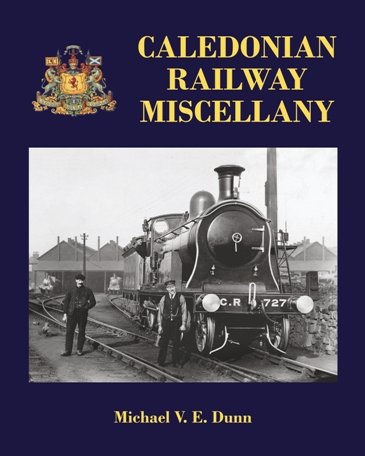
ISBN 978 1 9116400 12 2 Michael Dunn in conjunction with Kidderminster Railway Museum 2023. 320 pages The author, Michael Dunn, has spent the last ten years researching material for this book and amassing a large number of photographs and information to illustrate all aspects of the Caledonian Railway. The book takes the reader beyond the well-known photographs of the Caley's engines and trains into less familiar corners, conveying some impression of the lives of those who worked for this major transport undertaking. Of all of the old railway companies which once existed in Britain, the Caledonian was without doubt on of the most charismatic. It is a century now since it ceased to exist but its name is still spoken with affection. Like all industrial concerns of the time, working conditions could be harsh, with long hours and often low pay. Its staff did not view it through rose-tinted glasses but even so it engendered a fierce loyalty and is remembered today for its elegant locomotives, comfortable long distance trains, fine stations and the breath-taking scenery through which it passed. In truth, the Company made much of its money by transporting vast tonnages of goods and materials, and millions of commuters so the romantic scenery had to be contrasted with much industrial grime. Nevertheless, in everything it undertook, the Caledonian conducted its operations with an innate style and panache. Ten years in the making and containing nearly 400 images, the aim of this book is to take the reader beyond the familiar photographs of the Caley's engines and trains into darker, more obscure corners, and convey some impression of what life was like for those employed by this major transport undertaking. |
|
Richard Harman and Neil Parkhouse.
|
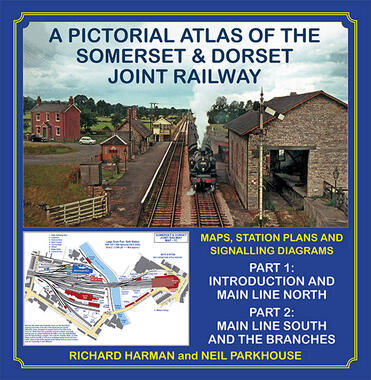
ISBN 978 1 915069 25 2 Lightmoor Press 2023. 468 pages - 2 volumes in slip case. A fresh new look at the Somerset & Dorset Railway, which, by means of detailed maps, follows the main line from Bath Green Park to Broadstone Junction. The journey on to Bournemouth West, on L&SWR/SR metals, is then included, after which we travel along the branches, from Evercreech Junction to Burnham-on-Sea (the original main line), Wells and Bridgwater. There are track plans and signalling diagrams for every location, all in colour. The maps are enlivened by a superb range of 1950s and '60s colour slides, picture postcards issued between the early 1900s and 1930, and early 19th century photographs, the majority of which have never been published before. As well as the stations passed along the way, time is also taken to study the industries and collieries the S&D served, plus the Company's Works and wharf at Highbridge. Together, these two volumes present a comprehensive picture of a much-loved cross-country railway which sadly is now just a memory. Part 1: Introduction and Main Line North, Part 2: Main Line South and the Branches. 468 pages. 275x275mm. Two volumes printed on gloss art paper with colour laminated board covers, presented in a colour laminated board slip case. |
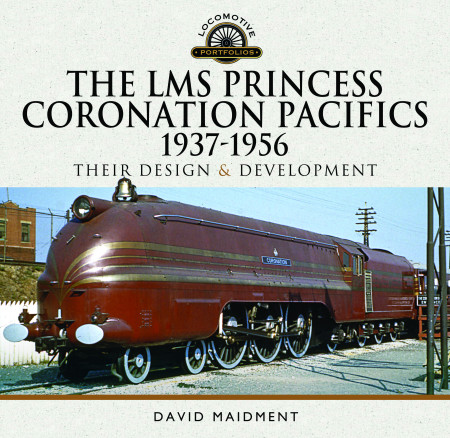
David Maidment.
|
ISBN 978 1 399085 77 9 Pen & Sword Transport 2023. 196 pages This book covers the design, construction, operation and performance of Sir William Stanier's masterpiece, the Princess Coronation pacific locomotives, better known as the 'Duchesses'. Included are pen portraits of the LMS engineers, a chapter on the express locomotives of the early LMS period that preceded their introduction and the internal rivalries and politics that Stanier was brought in to resolve. Chapters and photographs cover the streamline era, the war years and aftermath, the early years of nationalisation including the 1948 locomotive exchanges and the recovery of performance in the mid1950s. The author includes some of his own experiences and photographs. The book includes 200 photographs including a few in colour from the LMS era, and an appendix with weight diagrams, and statistics of the locomotive construction and withdrawal, names, liveries, allocations and mileages. David Maidment was a senior manager with British Railways, with widespread experience of railway operating on the Western and London Midland Regions culminating in the role of Head of Safety Policy for the BRB after the Clapham Junction train accident. He retired in 1996, was a Principal Railway Safety Consultant with International Risk Management Services from 1996 to 2001 and founded the Railway Children charity (www.railwaychildren.org.uk) in 1995. He was awarded the OBE for services to the rail industry in 1996 and is now a frequent speaker on both the charity and his railway career and author of five novels, a book of short stories, two non-fiction works on street children and over twenty books for Pen & Sword's locomotive portfolio series, the royalties from all being donated to the charity. |
|
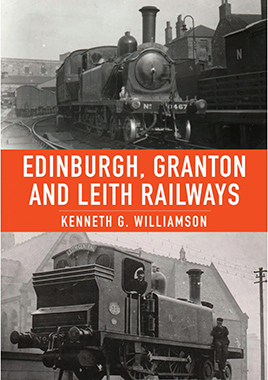
Kenneth G. Williamson.
|
ISBN 978 1 398108 56 1 Amberley Publishing 2023. 96 pages In 1861, the Caledonian Railway, in its efforts to gain a foothold in Granton and Leith, opened a line from Slateford to Granton with a connection to Granton Harbour, where the Edinburgh, Dundee & Perth Railway (NBR) was already established. The CR further built, at great expense, an elevated line to Leith Docks in an effort to establish itself in one of Scotland's busiest ports. Significant dock traffic never materialised and the CR's 1903 Leith New Lines failed. The North British Railway meanwhile, in their attempt to keep the CR out of Leith, opened Leith Central station in 1903 - the largest station constructed in Britain from scratch in the twentieth century. The station was much larger than necessary and as such was never used to its full potential. It was converted in 1955 to a Diesel Maintenance Depot and in 1972 closed completely. With a wealth of superb rare and previously unpublished images, Kenneth G. Williamson tells the story of Edinburgh, Granton and Leith railways. |
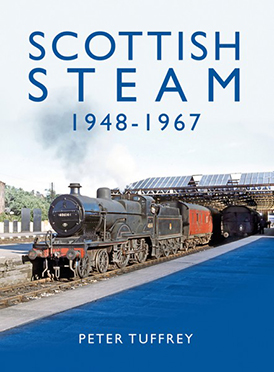
Peter Tuffrey
|
ISBN 978-1-914227-21-9 Great Northern Books. 160 pages Comprising one-third of the land mass of mainland Britain, Scotland provided a diverse background for railway photographers to record the end of steam. As dieselisation radiated northward from Southern England, the country became a refuge for locomotives and many enthusiasts rushed with their cameras to record the demise of a great period in British history. Scottish Steam 1948-1967 presents this era using nearly 250 superb colour and black-and-white images. The focus is on the various locomotives serving under BR at this time. These ranged from old pre-Grouping locomotives still in service, to the many LNER and LMSR designs introduced to modernise the respective motive power stocks after 1923. Following Nationalisation, many of the BR Standard Class varieties saw use in Scotland, whilst heavier freight duties were handled by ex-War Department 'Austerity' 2-8-0s that were brought into service under BR from the many war surplus engines. The locomotives have been pictured at locations across Scotland. From the cities of Edinburgh and Glasgow - including their environs - to places on the main lines radiating southward, such as Burnmouth and Beattock. Several sites on the Waverley route are included, in addition to the Ayrshire coast. Northward, Stirling, Alloa, Dundee, Aberdeen, Perth, etc., are featured, as is the West Highland and far north of Scotland - Thurso and Wick. The images have been taken at the lineside, stations, sheds, workshops and industrial locations. The book offers a fascinating record of the end of steam in Scotland. |
|
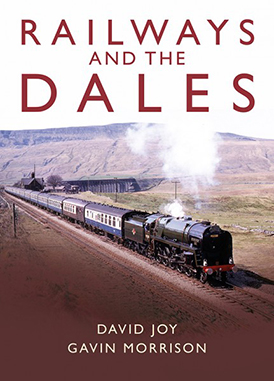
David Joy and Gavin Morrison
|
ISBN 978-1-914227-20-2 Great Northern Books. 128 pages. Here is a unique collaboration by two veteran recorders of the railway scene in words and pictures. Since 1967, David Joy has written over 50 books on railways and numerous aspects of the Yorkshire Dales. Gavin Morrison, one of Britain's most experienced railway photographers, has compiled more than 60 books and has gained the highest reputation for the quality of his work. They decided to celebrate four decades of working together in a book that is both informative and richly illustrated. Gavin first selected more than 150 of his favourite photographs depicting lines serving the Dales. David then wrote an evocative text emphasising how they have changed from the late 1950s through to the present day. The result is a nostalgic and reminiscent depiction of railways in a glorious corner of what has become known as 'God's Own County'. Coverage includes the legendary Settle to Carlisle railway, as well as many other lines ranging from forgotten branches in Nidderdale and Wensleydale through to electrified routes carrying commuters into the heart of Leeds. About the Author David Joy is from a family that has lived in Upper Wharfedale for more than four centuries. His passion for railways began in teenage days spent at Grassington station during its last years, when he was allowed to 'help' in the signal box and ride the footplate on the daily goods train. A former editor of the Dalesman, he has many countryside interests and has been awarded an MBE for 'services to the environment'. About the Photographer Gavin Morrison got his first camera way back in 1943 and within a few years his hobby became an obsession. He has now amassed some 200,000 images in one of the largest personal collections still in the hands of the original photographer. Unlike many, he did not put his cameras away when the age of steam ended in 1968 and he continues to record the changing railway scene. A dedicated Yorkshireman, he lives near Mirfield and has always had a special regard for the Dales. |
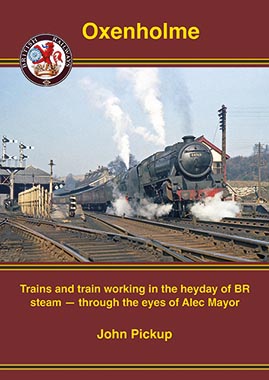
Photographs by Alec Mayor. Compiled by John Pickup.
|
ISBN 978 1 914248 01 6 Cumbrian Railway Society 2023. 52 pages This book portrays the railway scene around Oxenholme, a busy junction station at the foot of the Westmorland fells on the West Coast main line, in the heyday of BR steam from 1957 through 1961. It looks to convey the many fascinations of train-working, and the daily challenges and goings-on that encouraged local enthusiast Alec Mayor to keep unique and detailed records of train operation and time-keeping. Later, Paul Irving compiled them into a narrative rich with his personal insights as a Carlisle train controller. Though express passenger trains are naturally at thecentre of the story, local services, parcels and the many freight trains that passed north and south take their places too. Richly illustrated with Alec's own photographs and images from the wider collections of the Cumbrian Railways Association, the book draws on Alec and Paul's work to transport the reader back to enjoy the interest and excitement of those days again. As Ron Herbert, who spent some years early in his railway career as a train and traffic controller in Preston said, "It's a superb read - reliving the railway as I remember it all those years ago. This was the real railway in action!" |
|
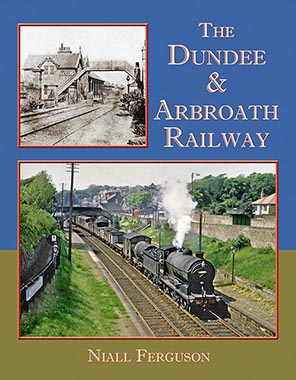
Niall Ferguson - an LMS Society Member.
|
ISBN 978 1 9150691 7 7 Lightmoor Press 2023. 224 pages The Dundee & Arbroath Railway, which opened for traffic in 1836, was the second of no fewer than four early railways in Tayside, three of which were based in Dundee. Originally independent, it was acquired in turn by the Scottish North Eastern Railway and then the Caledonian Railway, before the opening of the Tay Bridge brought it into the joint ownership of the Caledonian Railway and the North British Railway. With the 1923 Grouping, the Dundee & Arbroath then became a joint LM&SR and L&NER line before eventually becoming part of British Railways (Scottish Region). The line remains open today as part of the East Coast Main Line between London and Aberdeen. This book is the product of over forty years of research and includes around 250 illustrations, many not previously published, with a colour section, maps and signalling diagrams. The genesis and construction of the original 5ft 6ins gauge line is described, followed by its subsequent history down to the present day. The book complements the author's previous works on the Dundee & Newtyle and Arbroath & Forfar Railways. |
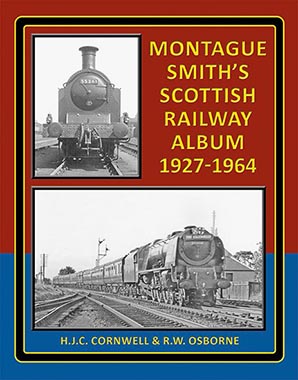
H. J. C. Cornwell & R. W. Osborne
|
ISBN 978 1 9150691 8 4 Lightmoor Press 2023. 112 pages The late Montague Smith was a Scottish railway enthusiast who devoted much of his life to a study of the steam locomotive. He was an acknowledged authority on many aspects of locomotive design and also a well qualified photographer. His 'home territory' was in and around Glasgow and down the former Caledonian stretch of the West Coast Main Line as far as Beattock. In this book, we make our way from Glasgow Central to Symington, junction for the Peebles Branch on which 'Monty', as he was always known to friends, took many photographs while holidaying in Biggar (the most important intermediate town on the branch) for the whole of August for many years. There he got to know many of the Carstairs enginemen who worked the branch and formed close and lasting friendships with a number of them. He became a regular and popular footplate guest of many drivers and, having learned much of their craft, was entrusted to drive both passenger and goods trains. Often with a camera to hand, he took many photographs, not only of the locomotives but also of their crews and other railwaymen involved in the work of the branch. Most of the locomotives were of Caledonian Railway origin, McIntosh and Pickersgill 4-4-0s and 0-6-0s, but early LM&SR standard classes such as 'Compounds', '4F' 0-6-0s, '2P' 4-4-0s and Hughes 'Crab' class 2-6-0s also played their part, and there were also some former Glasgow & South Western Railway Drummond 2-6-0s. However, larger and more modern engines such as parallel boiler 'Royal Scots' and 'Princess Royal' Class 'Pacifics', as well as streamlined and non streamlined 'Duchess' Class 'Pacifics', also feature in our journey from Glasgow to Symington. Day trips to Edinburgh, Stirling and Perth are also included and illustrate a mixture of former North British Railway and standard L&NER classes. Many of the photographs also identify the enginemen and other railway staff featured. |
|
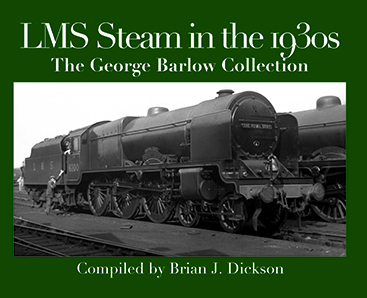
Brian J. Dickson (complier)
|
ISBN 978 1 913893 23 1 The Transport Treasury. 80 pages Out of necessity, picture books on the railways of generations past are restricted when it comes to the choice of images available; consequently a new collection is welcome, and this is what we have here in this selection from the George Barlow collection held at The Transport Treasury. Biographical notes on George's life as a driver and later Operating Manager on the Romney, Hythe and Dymchurch line are contained within the text, suffice to say it was some years before this, from 1933 onwards, that George was first recording the railway scene on film and in particular the contemporary LMS scene. Here he was able to record a time when the products of pre-grouping days were still dominant although the arrival of a certain Mr. Stanier was starting to be seen. Witness then everything from LNWR survivors and Midland stalwarts varying in size from crane-tank to a Beyer-Garrat, and progressing through the first Stanier tank engines to the Black 5, Princess and streamlined Coronation classes. What makes this collection so remarkable is that it is not restricted to loco only portraits, as George was adept at moving train shots as well. We are indeed fortunate as his collection has survived and may be appreciated by a wider audience. |
|
|
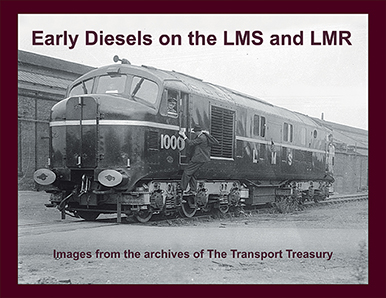
ISBN 978 1 913893 12 5 The Transport Treasury. 80 pages The LMS were the true pioneers of diesel traction on Britain's railways, both for shunting and main line purposes. Here examples of examples of locomotives from the earliest times on are depicted including much more information on the unique 'Fell' design. |
John Glover
|
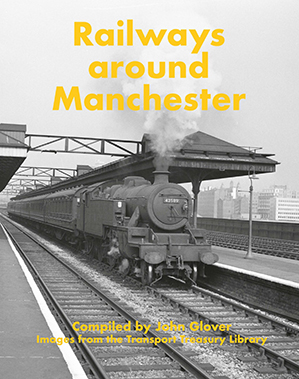
ISBN 978 1 913251 38 3 The Transport Treasury. 112 pages A book featuring a specific railway location is always best compiled by an individual with local knowledge, and that is indeed what we have here from former Manchester resident John Glover. John knew the railways around Manchester intimately at the time of transition from steam to diesel and electric and has used that knowledge to best effect in this all new title. Manchester had been in the forefront of electrification - two types - whilst co-terminus were diesel services and still considerable steam workings. |
|
David Spaven
|
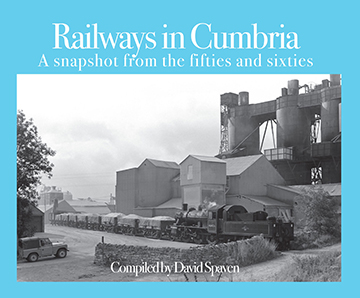
ISBN 978 1 913893 20 0 The Transport Treasury. 80 pages Even in today's rationalised railway world, Cumbria - England's most north-westerly county - offers a microcosm of what the iron road does. This variety was all the greater in the heyday of the railway, shaped by a distinctive geography and major economic forces in the form of mass tourism and concentrated industrial development. Add to the mix a lengthy coastline indented by estuaries and rivers such as the Coniston, Derwent, Duddon, Eden, Esk and Kent - and a strategic position en route from London to Glasgow - and you have a recipe for a glorious railway geography and history. This unashamedly nostalgic album depicts the railways of the county using images primarily never before seen. Commencing at the county town of Carlisle the coverage ranges out clockwise covering the period 1939 to 1970 and from steam through to the early diesels. The famed Settle & Carlisle also naturally features, as well as routes that succumbed to Dr Beeching but are now brought back to life in these pages. |
Jeffrey Grayer
|
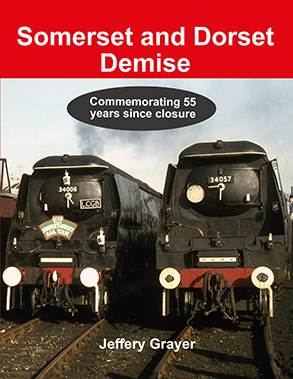
ISBN 978 1 915281 00 5 The Transport Treasury. 112 pages "Swift & Delightful", "Slow & Dirty", "Sabotaged & Defeated", the Somerset & Dorset Railway has attracted many soubriquets over the years, not all of them complimentary. However, this fascinating route, which closed over half a century ago, still has a dedicated following amongst that sadly declining band of former passengers and staff who knew it in its operational days and amongst those too young to have experienced the delights of its picturesque route, its wide variety of motive power, its range of through expresses and local trains, and the friendly staff who served local communities through decades of loyal service. This collection of colour images assembled by Jeffery Grayer recalls the sad decline of its later years and follows on to the eventual closure and demolition of the route such that today the only track remaining is in the hands of dedicated preservation societies who seek to keep alive the spirit of the old line. |
|
Stuart Ashworth
|
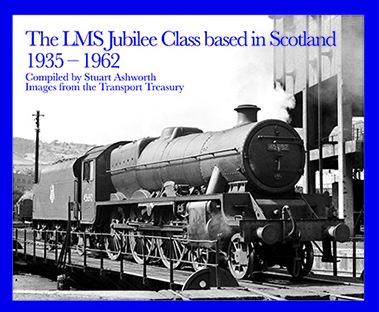
ISBN 978 1 913893 15 6 The Transport Treasury. 80 pages A firm favourite in steam days, the LMS design Jubilee class has previously received much attention so far as technical information and workings on the LMS/ LMR system as a whole is concerned. Never before though has a detailed look been taken at the workings of the class concentrated north of the border. This is a surprise as right from the start engines of the class had been based at both Perth and Aberdeen. In addition no less than 50 examples were built by the North British Company at their Queens Park and Hyde Park Works in Glasgow. In this new book author Stuart Ashworth describes and illustrates the work of the class in both LMS and later BR days using technical and factual information but supplemented by personal accounts and observation. The result is a new look at a famous class and one which served the railways proud for almost three decades. Illustrated throughout, examples of the type are portrayed in good and not so good days, working different types of train, at rest and also under repair. Where possible the images used have not been previously published so making this a must for devotees of the LMS and its successor the LMR. |
Peter Sikes
|
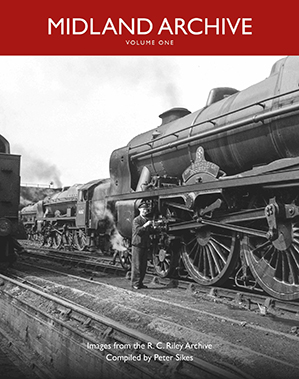
ISBN 978 1 913251 23 9 The Transport Treasury. 112 pages This is the first foree 'north of the Thames' in the R C Riley archive. Starting in 1937 Dick Riley captured over 18,000 black and white UK railway images, only a small proportion of these photographs have ever been seen. Hopefully that may be addressed with volume one of 'Midland Archive', part of a series dedicated to specific railway themes. It is clear to see that Dick had a passion for all things railway - locomotives, trains of all kinds, infrastructure and railway staff. You will find examples of all of these in this book, showcasing some of the best of his photography as well as a fascinating selection of his images recorded from 1954 to 1965. |
|
Noel Coates - an LMS Society Member.
|
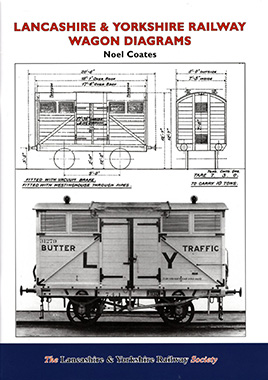
ISSN 1460-9894 Lancashire and Yorkshire Railway Society 2022. 64 pages This book illustrates all the diagrams in the official L&Y Diagram Book with additional information on build dates, numbers built, and usage. There is also a photograph of each type (except a small number for which no known photo exists). This compliments Noel's two major volumes of L&Y wagon history and is also invaluable as a reference book in its own right. |
John Jennison - an LMS Society Member.
|
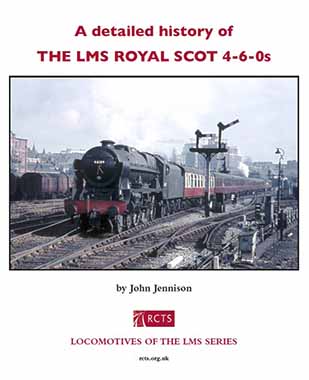
ISBN 978 0 9934908 7 3 RCTS 2022 This book is a detailed history of the LMS Royal Scot class and has been written by well-known railway author John Jennison. The Scots were the first express locomotives designed by the LMS and were its principal passenger engines from 1927 until the mid-1930s. Their story is one of ups and downs from the high of their debut, setting records for non-stop working, and a highly successful tour of North America in 1933. However, a number of problems emerged with their initial design and although these were rectified in the mid-1930s under Stanier, the Scots had to take second place behind the new Pacifics. A key part of the story which eventually led to their renaissance following rebuilding with taper boilers from 1943 was the ill-fated experimental high-pressure locomotive Fury which was based on the standard Royal Scot. This experiment was brought to an end after five years and what could be salvaged was used in the rebuilding as British Legion, which was effectively a prototype for the improvements subsequently carried out on the class. In the British Railways 1948 Locomotive Exchanges, the rebuilt engines were pitted against larger and more powerful Pacifics where they more than held their own. The 1950s saw the class continue to work heavy express duties on the West Coast main line and also on the Midland lines. The story is completed with the two preserved members of the class which are now in regular use on the main line. The book is presented in the usual RCTS style with chapters covering Design, Construction, Boilers, Tenders, Work, Modifications, Operations etc; this work runs to 264 pages. The text is accompanied by 144 black and white images from construction through to the mid-1960s, with all eras covered. Extensive tables are included covering allocations, liveries and works visits. |
|
Dave Richardson.
|
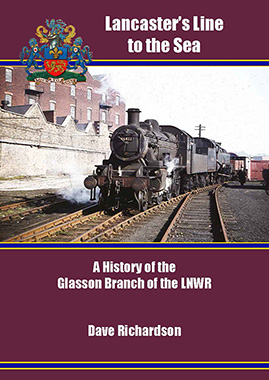
ISBN 978 0 9570387 9 0 Cumbrian Railways Association 2022. 88 pages Written by Cumbrian Railways Association (CRA) member and author, Dave Richardson, this book tells the history of the branch from Lancaster Castle Station to Glasson Dock. From 1883, when the line was opened, the operation of the port was in many respects a collaboration between the Lancaster Port Commissioners and the London & North Western Railway (LNWR). The relationship between these two bodies is fully explored. For most of the line's existence, rail traffic at the Lancaster end was dominated by the activities of James Williamson & Son, linoleum manufacturers, who, by the eve of the Great War, commanded huge markets at home and abroad. Williamson's colossal Lune Mills sat alongside the branch and the firm's archive has been examined with a view to providing a detailed account of its relationship with the railway. The book covers the origins of the project, construction of the branch and its operation under the LNWR and its successors. There are also separate chapters on locomotives and passenger rolling stock and signalling/train control. It is comprehensively illustrated with coloured maps, drawings and a large number of photographs - many locally sourced and previously unpublished. CRA Chairman, Philip Tuer, says: "This new book, the third by Dave Richardson, follows other successful publications by the CRA in the last few years. This shows that our Association continues to meet a need for greater interest and understanding of the railways in and around Cumbria and the people and places they served." |
David Maidment
|
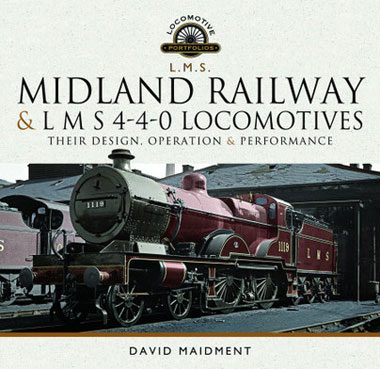
ISBN 978 1 526772 50 3 Pen & Sword Transport 2021. 352 pages David Maidment has unravelled the complex history of the Johnson, Deeley and Fowler 4-4-0 locomotives of the Midland Railway and its LMS successor, covering their design, construction, operation and performance in this book with over 400 black and white photographs. It recounts their working on the Midland main lines from St Pancras to Derby, Manchester, Leeds and Carlisle, the latter via the celebrated Settle & Carlisle line, and the later work of the Fowler LMS engines on the West Coast main line. The book also describes the history of the Midland 4-4-0s built for the Somerset & Dorset and Midland & Great Northern Railways. The book covers the period from the first Midland 4-4-0 built in 1876 to the last LMS 2P withdrawn in 1962 and includes performance logs, weight diagrams and dimensions and statistical details of each locomotive. 300 black and white illustrations, weight diagrams and logs |
|
W. R. Mitchell
|
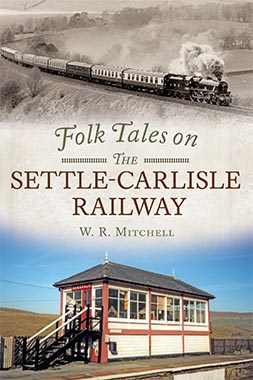
ISBN 997 8 17815532 1 3 Fonthill Media 2015. 112 pages In Folk Tales on the Settle-Carlisle Railway, join the driver and fireman on the footplate of a locomotive. Stand behind a range of levers in a signal box or be one of a gang working on the permanent way, sweating in the summer heat or shivering after a heavy snowfall. Maintenance men in Blea Moor tunnel needed patience and good lungs; the tunnel might be thick with locomotive smoke or draped with icicles. On the Settle-Carlisle journey, we are thrilled by a slowly changing landscape, glancing at Pen-y-ghent, which crouches like a lion above Ribblesdale. Further north, we admire the broad acres of the Eden Valley, which lie between the Northern Pennines and the gaunt fells of the Lake District. An afternoon passenger train that took in the line from Garsdale to Hawes was named Bonnyface; when it turned up, workers smiled as they were about to go home. The Garsdale tank house was used for dances and an adjacent wheel-less carriage was the refreshment room. |
Michael Clemens
|
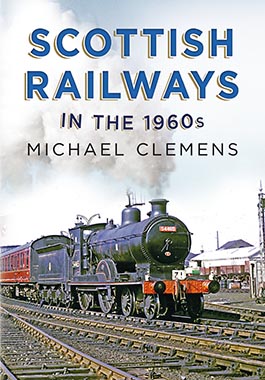
ISBN 997 8 17815576 1 7 Fonthill Media 2019. 128 pages Scottish Railways in the 1960s makes a clockwise journey around the country visiting many long-closed railways, branch lines, a few industrial locations, plus the locomotives that worked over them. Locations seen include Alloa, Alva, Auchtermuchty, Ayr, Ballachulish, Beattock, Brechin, Burghead, Dumfries, Callander, Carstairs, Castle Douglas, Coalburn, Douglas, Drongan, Duns, Edinburgh, Elgin, Fort William, Georgemas Junction, Glasgow, Gleneagles, Greenock, Hawick, Helmsdale, High Blantyre, Inverness, Killin, Kilmarnock, Larkhall, Lennoxtown, Lesmahagow, Lugar, Montrose, Muirkirk, Paisley, Rannoch, Stonehouse, Stranraer, Thurso and Turriff. The time period is mainly between 1958 and 1966, and steam motive power largely dominates except in the far north. This beautifully illustrated book will appeal to railway enthusiasts, modellers and those interested in local history. Most of the photographs have never previously been published and all were taken by the author, his father, and Alan Maund. An extensive and informative commentary accompanies the photographs. |
|
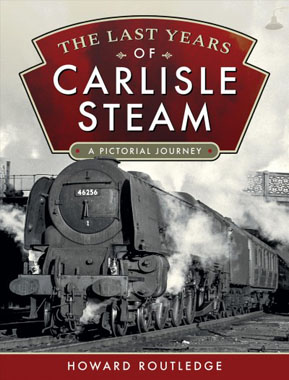
Howard Routledge.
|
ISBN 978 1 526773 58 6 Pen & Sword Transport 2021. 120 pages Mention the name Carlisle to any steam enthusiast of a certain age and they will probably conjure up an image of bygone days when Stanier and Gresley pacifics rubbed shoulders alongside each other within Citadel station whilst waiting to relieve incoming titled trains such as the Royal Scot and the Waverley. Such scenes, in addition to steam locomotives threading their way across a network of goods lines, and the city's three surviving motive power depots, were all subjects captured on film by a number of young enthusiasts who lived in Carlisle during the final years of steam. It is the work of those cameramen, aided by others who visited the area, that will offer the reader an insight as to the variety that still prevailed at Carlisle during that time. Looking slightly further afield, images are also included which feature locomotives working hard on those steeply graded lines that radiated from the city towards summits with names to capture the enthusiast's imagination, such as Shap, Beattock, Whitrope, and Ais Gill. This book, which illustrates in depth one of the country's major steam centres, contains more than two-hundred photographs, presented in both colour and black and white, the majority of which have not been published previously. 200 colour & black and white illustrations & a station map |
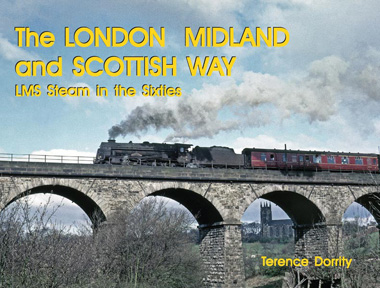
Terence Dorrity
|
ISBN 978 1 911262 43 5 Irwell Press 2021. 128 pages A personal colour odyssey by an author captivated by steam, like most of us, at an early, highly impressionable age and in his case the introduction was grander than most - the Royal Train passing through Henley-in-Arden in April 1950 headed, memorably by two Castles. 'I lived in Stratford-upon-Avon at the time the photographs in this book were taken and there were London Midland Region main line strongholds within very easy reach. My father worked in Birmingham and I would sometimes spend a day at New Street station which was still divided by Queen's Drive between the ex-LNWR and Midland Railway platforms before it was 'modernised'. I was particularly fascinated by the Harborne Branch which was worked at the time by Johnson Midland Railway 2F 0-6-0s from Monument Lane shed. There were also visits to local Midland Region sheds, Saltley, Aston, Monument Lane, Bescot and Bushbury, as well as, in retrospect, logistically quite complicated trips. I recently found details of one of them, on Sunday 14 June 1959, when I visited Nuneaton, Stafford, Stoke, Alsager, Uttoxeter and Burton. Phew!' The mainly full-page colour photographs of ex LMS locomotives in the 'London Midland and Scottish Way' were taken by Terence Dorrity between 1960 and the very last day of British Railways main line steam; the 'Fifteen Guinea Special' on 11 August 1968. Locations range from London to Carlisle in England, into Scotland and Wales and over to Northern Ireland. CONTENTS
|
|
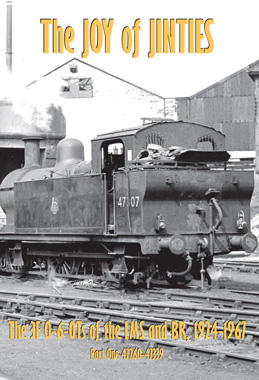
Ian Sixsmith.
|
ISBN 978 1 911262 33 6 Irwell Press 2021 The well known LMS 'Jinty' 0-6-0Ts originally known as the 'standard shunting tanks' came to number over 400, built over the years 1924-1931. The origin of the name is subject to various theories but in effect is lost in antiquity. The Tri-ang model of a Jinty, the famous 47606, was one of the best selling OO scale toy/models of all time and was often the first engine encountered by small boys who went on to enthuse over locomotives and railways for the rest of their lives. The new Jinties flooded across the LMS and through to the middle 1960s could be found labouring daily the length of the land; pilots at the great stations, from Euston to New Street to Preston to Carlisle, or pottering in remote sidings. There was an endless variety of trip workings and local freights, ambling the length of a branch or collecting and delivering wagons to a series of outlying yards. They long survived the onset of diesel shunters and were only finally extinguished in 1967. Lest the Jinty be remembered only as a 'shunter' it can be noted that plenty of passenger work came their way at first. Easily the most remarkable was their employment on GN suburban workings including the main line, cheek by jowl with racing Gresley Pacifics. A particular sphere of working the Jinties made their own was the transfer freight, a Victorian mode of working lasting effectively to the end of steam; every city abounded in the work, from London to Glasgow, with Carlisle being a particularly glorious, example. A Jinty truly was a Joy. |
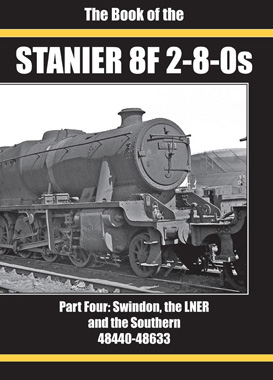
Ian Sixsmith & Richard Derry.
|
ISBN 78 1 911262 42 8 Irwell Press 2021 Latest in the longstanding 'Book Of' series, in FIVE PARTS to adequately cover the vast number of locomotives involved. In this fourth part are the rest of the locomotives turned out by the Great Western at Swindon and those appearing from the Southern and the LNER. All the usual works histories and allocations are here for every loco; liveries and tender varieties, experimental episodes and every other facet of these mightily impressive 2-8-0s, which survived to the very last days of BR steam. The Story So Far: |
|
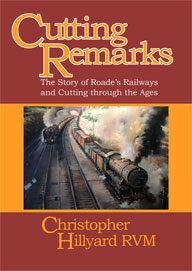
Christopher Hillyard RVM.
|
ISBN 978 0 956349 62 0 Roade Local History Society 2021 Roade cutting was considered to be one of the great works in the construction of the original London and Birmingham Railway ( now known as the West Coast Line ) between 1833 and 1838, being about 1½ mile in length, of considerable average depth, a good part of which consisted of hard rock-the Great Oolite Limestone. Running to 240 A4 pages and 65,000 words with over 300 illustrations in both black & white and colour the stories, personalities and events recorded within this publication include:
|
John Jennison - an LMS Society Member.
|
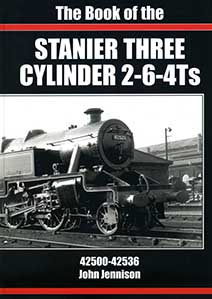
ISBN 978 1 911262 38 1 Irwell Press 2020 The LMS had over six hundred 2-6-4Ts, evolving from the parallel boiler Fowler engines through updated Stanier taper boiler versions to Fairburn's final development. The first Stanier engines were wholly different in having three cylinders; moreover they were (most unusually) restricted to one particular stretch of line. Apart from the war years when they were all temporarily transferred away, they could always be found working passenger services over the former London Tilbury & Southend system from Fenchurch Street to Southend and Shoeburyness, until ousted by electrification in 1962. As the information board alongside the preserved 2500 in the National Railway Museum at York pronounces: 'Possibly the finest suburban tank engines that ran in this country'. |
|
John Jennison - an LMS Society Member.
|
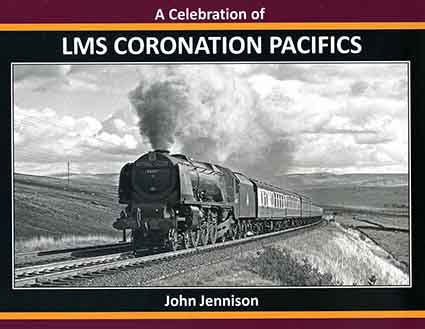
ISBN 978 1 911262 36 7 Irwell Press 2020 The first in a series which uses top quality photographs reproduced at the largest possible size to celebrate some of the best-loved steam classes. Full-page shots are presented in a landscape format and are backed up by comprehensive captions. What better place to start then than the Stanier Coronation Pacifics of the LMS? The emphasis throughout is on the engines in service and the book has been arranged in chapters in chronological order starting with the four main variations of the class as built, followed by the post-war de-streamlined engines. The final three chapters show the Coronations at work in the 1950s and 1960s on each of the principal routes where they were used, ending with the final few months of 1964. All engines in the class are covered at least once. The pictures have been selected from the collections of Rail-Online and Brian Stephenson's Rail Archive Stephenson and include many taken by Jim Carter and Bill Anderson. Jim was a railwayman based at Patricroft which gave him access to locations in the north west not available to other photographers. Bill Anderson took some of the finest pictures ever taken in this country as the engines worked over Shap and Beattock. |
H. J. C. Cornwell.
|
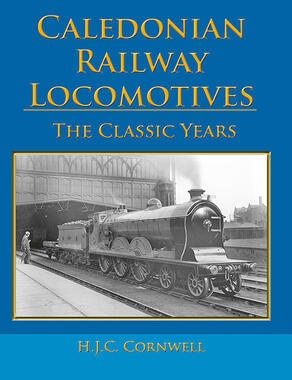
ISBN 9781911038757 Lightmoor Press. The Classic Years of the Caledonian Railway's locomotives cover the designs of Dugald Drummond, John Lambie, J.F. McIntosh and William Pickersgill. During this period, the Company was at the forefront of locomotive design and produced, particularly in the 4-4-0s, the classic Victorian British locomotive. For express passenger work, locomotives capable of climbing to Beattock summit and running the long distance from Carlisle to Perth were required. For goods traffic, the numerous collieries and industrial plants of the Central Belt had to be handled, together with the associated shunting at numerous sidings and yards. Weight restrictions on the hilly Callander & Oban line required bespoke designs. Throughout the period, passenger locomotives displayed the Company's distinctive blue livery which set them apart from all others. In this volume, the author describes the design practices developed by each of the Locomotive Superintendents, followed by details of each class, accompanied by suitable drawings and illustrations. The Caledonian's express trains attracted the attention of several enthusiasts of the day, whose recordings provide added detail of locomotive performance. Together with David Hamilton's Caledonian Locomotives: The Formative Years, these two volumes provide the definitive history of Caledonian Railway motive power. |
|
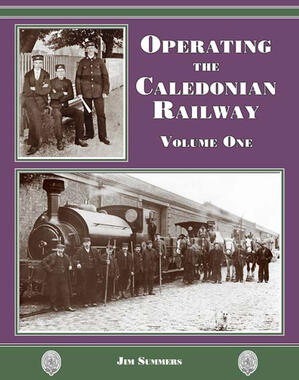
Jim Summers - an LMS Society Member.
|
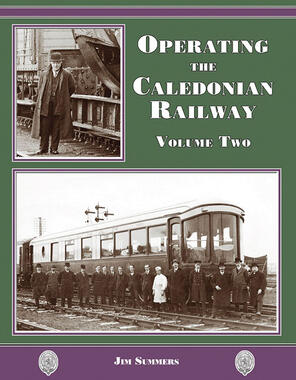
ISBN 9781911038719 Lightmoor Press This volume looks at how the Caledonian planned its operations and how it handled matters when things did not go according to plan. The constraints and possibilities of track layouts are considered, followed by an explanation of the art of compiling timetables and the workings of the rolling stock in order to make the most of that infrastructure. Did a L&NWR Manchester guard regularly work the Balerno Branch? The methods of dealing with particular traffics and controlling assets, from wagons to sacks, are described. Carlisle Control office is featured and the significance of traffic control in the Quintinshill accident is explored. The operating practices for some important flows of traffic are examined, with a chapter on electrification, for which the Caledonian sought powers. The reader will feel an affinity with the traffic men and understand the issues with which they grappled, while students of other railways will wonder how their companies addressed similar questions. |
John Jennison - an LMS Society Member.
|
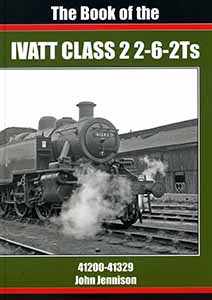
ISBN 978 1 911262 34 3 Irwell Press 2020 The Ivatt Class 2 tanks and moguls were amongst the last new LMS designs and although intended for secondary duties to replace a variety of ancient pre-grouping specimens, they incorporated all of the refinements developed over the previous decade and honed by Ivatt on his post-war Black Fives. The two classes were developed together, using the same boiler, sharing as many components as possible and they were very much complementary. Operationally, they worked mostly in different areas and on different duties and hence the story of the tender version is covered separately in the Book of the Ivatt 2-6-0s. There was no class that was so immediately and universally accepted by enginemen. Not only did they welcome both the tender and tank versions with open arms, "they worshipped the very rails they stood on". The 2-6-2Ts were really the last small tank locomotive designed for Britain's railways; the BR Standard Class 2 in the 84000 series being merely a slightly modified version. Their light axle loading meant that they could go almost anywhere on the system and they certainly did that. They operated throughout the Southern Region, from Kent to Cornwall, as well as almost everywhere on their native LMS; the only area where they did not work at all was Scotland. |
|
John Jennison - an LMS Society Member.
|
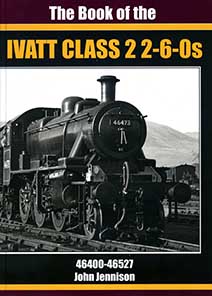
ISBN 978 1 911262 26 8 Irwell Press 2019 As the LMS Press Release explained at the time, the newest LMS 2-6-0s, though of small size and light weight, incorporated 'every modern development which has been found successful on the larger main line types.' They had self-cleaning smokeboxes, manganese steel axlebox liners, rocking grates and hopper ashpans. Externally, the high running plate and outside cylinders contrasted with the rather ancient looking large diameter chimney. The tender cab and inset tanks were designed for tender-first operation. The Class 2 moguls and the contemporaneous Class 2 2-6-2Ts were amongst the last new LMS designs and although intended for secondary duties, they incorporated (just like the Press Release said!) all of the refinements developed over the previous decade and honed by Ivatt on his post-war Black Fives. The two classes were designed together, sharing as many components as possible, using the same boiler, and they were very much complementary. The Book of the Ivatt Class 2 2-6-0s follows the series customary format; detailed essay on provenance, development, historical content, tables of works histories and allocations, photographs of every locomotive. |
David Hamilton.
|
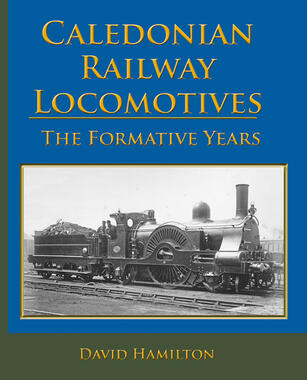
ISBN 9781911038566 Lightmoor Press. The Caledonian Railway was a major company. Its lines spread from Carlisle to Glasgow, Edinburgh and Aberdeen, and it partnered the London & North Western Railway in operating the West Coast route, the first to run through trains from London to Scotland. Within Scotland, it served much of the industrial central belt, carrying significant volumes of coal and iron from a multitude of small mines and works. This required a large stock of goods and mineral locomotives, whilst passenger trains varied from expresses linking the major cities to humble tanks operating rural branch lines on relaxed schedules. The first lines of the Caledonian Railway opened in the late 1840s but some of its later absorbed constituents dated from the 1830s. The locomotives varied from the 8ft singles to the humble shunting tank. The Caledonian was at the forefront of several developments in locomotive design as it evolved to meet these needs. In this book, the author describes all the locomotives built for the Caledonian and its constituents up to 1882. That is a convenient point to conclude this volume as it marks the retirement of George Brittain. His successor, Dugald Drummond, introduced a number of changes in design that will be described in the second volume which will conclude the story of Caledonian locomotives. Several significant developments are covered within these pages, as the early engineers struggled to understand the basic principles of locomotive design. Coal took the place of the more expensive coke and the proportions of smokebox, firebox and boiler had to be adjusted. Proper braking had to be installed and even the poor locomotive crew had to be treated to more than a thin weatherboard as speeds increased. By treating these early aspects of design in detail, this book will appeal not only to those with a specific interest in the Caledonian Railway but to a wider audience who want to know more about how the Victorian steam locomotive developed. |
|
Jim Summers - an LMS Society Member.
|
ISBN 9781911038511 Lightmoor Press Engineers provided equipment and accountants provided the money, but it was the traffic men who put everything together and made a railway run coherently. Their art lay in understanding and exploiting the capacity of their railway, mastering fluctuations in traffic, deploying resources, coordinating staff, and facing passengers and freight customers. 'Operating' the railway was - and remains - a far-reaching and complex task. What were the correct dimensions of a train? How was the timetable compiled? Who or what was a 'leader'? Who planned the troop train in the Quintinshill accident? With half a century of experience in the railway industry, the author sets out to explain how things were done on the Caledonian Railway and how its methods compared with others. For students wishing to understand how railways really functioned, the two volumes in this series will provide a different insight by fleshing out theory with real-life, down-to-earth practice on a major railway. |
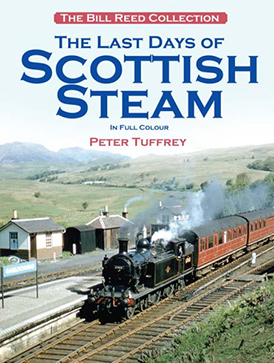
Peter Tuffrey
Photography by Bill Reed
|
ISBN 9780957295179 Great Northern Books 2018. 160 pages Noted railway photographer Bill Reed shows his pin-sharp colour pictures of the last days of Scottish steam for the first time in this lavish, 160 page, hardback book. Bill, now 79, Nottingham-born and an ex loco driver, took colour slides on his many journeys north of the border in late 1950s and early 1960s. In some cases Scotland was the only area operating the once famous Gresley A4 locomotives and Bill wasted no time in capturing them on their last duties. The pictures illustrate steam locomotives trundling along many of the branch lines now long gone; waiting in sleepy stations, long abandoned; as well as pausing on shed or dumped on scrap lines, awaiting their ultimate fate. Bill had access to most areas to take pictures and was not hampered by restrictions and regulations as he would be today. This is much to the reader's advantage as we see shots that would normally be difficult to obtain. He also illustrates how complicated and labour intensive it was operating a steam loco; the vast coal hoppers and water tanks provide examples of this testimony. For easy reference, the book is set out in a simple A-Z format starting with Aberdeen and finishing at Tyndrum Upper station. Noted locations are featured in-between these points, including all the Edinburgh and Glasgow sheds as well as Connel Ferry, Gleneagles, Inverurie and many more. Bill has marvellously captured the post Second World War atmosphere on Scottish railways. If he had his time again he says he would have taken a lot more pictures. But that is no matter, we have enough here to remind us quite clearly what it was like during the last days of Scottish steam. |
|
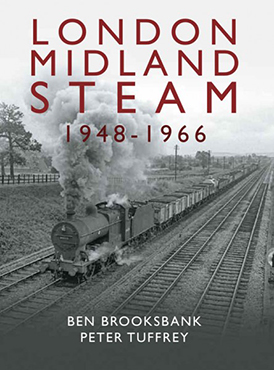
Peter Tuffrey
Photography by Ben Brooksbank
|
ISBN 978-1-912101-92-4 Great Northern Books 2018. 192 pages. The book concentrates on the London Midland Region in the final years of steam traction covering the period 1948 to 1966. All major London Midland Region towns and cities are represented. A fascinating collection of hitherto unpublished black and white photographs by former Senior British Medical Council researcher, Ben Brooksbank. Over 275 photographs are included. - The photographs show remarkable clarity even though photographic materials were difficult to obtain during the immediate post-war period. Many different classes of locomotives are featured, ranging from the old Midland and LNWR engines ready for withdrawal in the late 1940s, the ex-MR Johnson 0-6-0s which would survive a little longer, the Fowler classes quietly going about their business, the Stanier Class 5 and 8Fs covered in grime, but still efficient, while a bit of 'glamour' is provided by (some) neatly turned out 'Jubilee' 4-6-0s and 'Coronation' Pacifics. The next generation of locomotives � the BR Standards � also appear, with the 'Britannia' Pacifics included along with Class 5 4-6-0s, Class 4 4-6-0s, Class 4 2-6-0s, Class 3 2-6-2Ts and the heavy freight 9F 2-10-0s. Photographs have been taken from the line-side, on station platforms, on shed, around a number of Works and along lines which have long since disappeared. The captions are well researched and include locomotive details as well as historical information about the various routes, stations and other architectural features. |
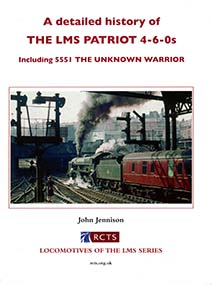
John Jennison - an LMS Society Member.
|
ISBN 978 0 9934908 1 1 RCTS 2018 This book describes the origins and development of the class, the modifications including the taper boiler rebuilds, liveries, allocations, names and the operating areas in which they worked. The text is supported by 141 black and white and 18 colour illustrations. With the permission of The Patriot Trust a chapter has been included concerning the planned new build Patriot to be known as The Unknown Warrior. This describes the planning setbacks and progression towards the eventual completion of the locomotive. |
|
John Jennison - an LMS Society Member.
|
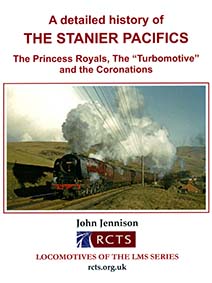
ISBN 978 0 9934908 0 4 RCTS 2017 This book covers the detailed history of the LMS Stanier Pacifics. The author examines all aspects of their development and their evolution from the first Princess Royals through to the final Coronations, and also includes a detailed account of the "Turbomotive" project. A must for those with an interest in LMS locomotive history and devotees of these magnificent engines. This book describes their construction, modifications, liveries, allocations, and names. The text is supported by 177 black and white and 48 colour illustrations. |
Harry Knox.
|
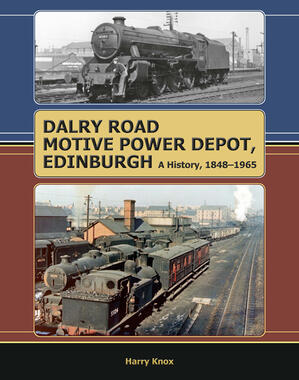
ISBN 9781911038412 Lightmoor Press. The Caledonian Railway was something of a latecomer to the Edinburgh railway scene, but proved it was not backwards in extending its hold on the city and environs. Thwarted by the NBR in its attempts to access the docks at Leith and Granton, it pursued its own agenda in serving the burgeoning industries in both West and Midlothian. A passenger railway from the outset, a small 'engine house' was constructed in the Dalry Ward of the city, known as Dalry Road MPD, which eventually provided motive power for both the significant passenger train service, and the mineral and goods traffic being handled. It also provided power for an intensive suburban passenger service to the north and west of the city. The 'Caley' was to prove a much-loved institution in Edinburgh. |
|
Mike Williams.
|
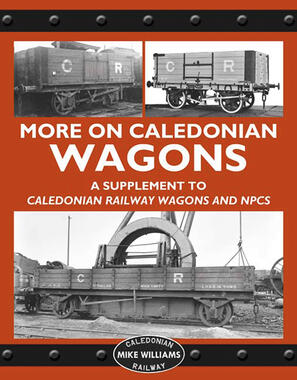
ISBN 9781911038337 Lightmoor Press When Caledonian Railway Wagons and Non-Passenger Coaching Stock was published in early 2013, there were inevitably a number of loose ends and unresolved questions. Since then new evidence and photographs have come to light which, coupled with contributions from members of the Caledonian Railway Association Forum, have answered many of the queries and added new information about the diverse CR wagon fleet, its development and livery. The volume includes a discussion on the financial aspects of wagon building, maintenance and replacement, followed by a detailed analysis of the CR's search for the optimum capacity mineral wagon, illustrated by drawings of proposed wagons discovered in the Stratford Works collection at the NRM. Chapters on private trader wagons, merchandise and livestock wagons, and special class designs are followed by a revised description of brake van development, including a section on the extensive use of seemingly primitive brake wagons well into the 20th century. Finally an appendix gives details of the number and type of wagons built by outside contractors, who supplied the CR with almost all their new-built wagons before the Drummond era. |
John Jennison - an LMS Society Member.
|
ISBN 978 0 901115 99 7 RCTS 2015. This volume continues with the story of these locomotives known to enthusiasts as "Black Fives". The author picks up the story of the class after Volume 1 dealt with the 472 Class 5s built before the Second World War. He continues with the development of the class under George Ivatt and the 370 engines that were introduced between 1943 and 1951. The book therefore introduces us to Caprotti valve gear, Stephenson motion and roller bearing axleboxes together with the tests and modifications required. The 1948 Interchange Trials are also featured with details of the test runs involving Class 5s. The volume includes many facts and figures on the class to accompany the detailed text and contains 126 black & white and 48 colour illustrations. |
|
John Jennison - an LMS Society Member.
|
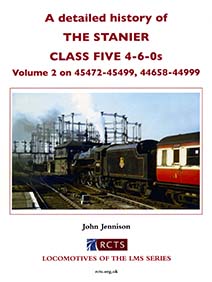
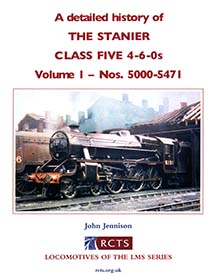
ISBN 978 0 901115 98 0 RCTS 2013 This is the first of two volumes covering the design, development, construction and operation of one of the most well known and largest classes of steam locomotives ever to run on the railways of Great Britain. Tthe book maintains the very high standard of detail and accuracy which is the hallmark of RCTS publications. Lavishly illustrated with black and white photographs from the introduction of the class through to the 1950s and with many diagrams and tables of data. |
Andrew F. Swan.
|
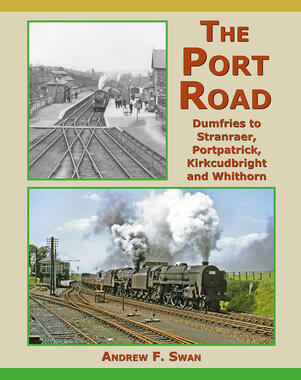
ISBN 9781911038214 Lightmoor Press. The Shortest Sea Route between mainland Britain and Ireland, the twenty mile crossing between Stranraer and Larne, was a jewel in any railway crown. Eighty-one miles of largely single track railway were built from Dumfries through inhospitable, barren uplands to Stranraer. The Caledonian Railway operated the line for the first two decades but then joined with the Glasgow & South Western, the Midland and the London & North Western railways, each buying a quarter share to create, in 1886, 'the Jointest of All Joint Railways'. The Scottish companies operated the line and took alternating responsibility for its upkeep. Passengers, the Royal Mail, goods and considerable war-time traffic mixed with stopping local trains. The line was operated with a variety of pre-Grouping rolling stock, signalling and motive power rarely seen. Within these pages, Andrew Swan outlines the history of the line and its branches, and gives a detailed description of each of the stations along the route, with a 32-page section of buildings and rolling stock plans all in colour. Further chapters cover train services, signalling and some of the staff who worked on the line. Railway enthusiasts, modellers and anyone interested in local history will find much to enjoy in this lavishly illustrated book. |
|
Harry Knox
|
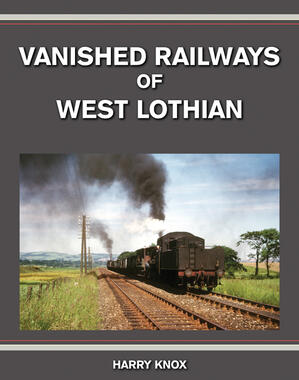
ISBN 9781911038177 Lightmoor Press West Lothian (Linlithgowshire), despite being one of Scotland's smaller counties and compact in area, lies on lands that have been occupied from way back into pre-historical times. It also sits astride a field of oil-bearing shale, some 75 square miles in area, which was to effect Scotland's first oil boom, as well as rich measures of quality coal, limestone, fireclay and ironstone, these latter being in ever-increasing demand by the burgeoning iron and steel industry of the late 1800s. Inevitably, these mineral riches required dependable transportation to the users and customers, and railways were to provide the means. By the early 1900s, the county, with some twenty oil works and refineries, was to be criss-crossed by four main lines of railways, a myriad of branch lines and sidings connected thereto, and a network of both private standard gauge and narrow gauge railways serving both the mining operations and the finished products based on these mineral riches. This book examines the growth, the zenith and the inexorable decline of these lines and is illustrated with over 300 mostly previously unpublished photographs, plus maps and route diagrams. |
Jack Kernahan.
|
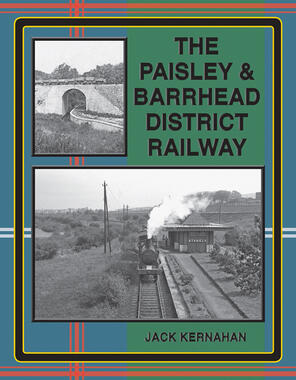
ISBN 9781911038108 Lightmoor Press. This is the story of a railway built to the highest engineering standards, comprising two lines, one of double track and the other single, with seven passenger stations, none of which was ever opened. Consequently, although it managed to eke out a sixty-year existence as a goods line, this obscure and largely unknown backwater never came close to returning a profit. Although having its origins in schemes dating back to the 'Railway Mania' of the 1840s, it was not until 1897 that the Paisley & Barrhead District Railway received Parliamentary approval and another year before the contracts for its construction were let, with opening throughout set for 1901. Bedevilled then by slow progress in the building work, with the weather, the death of the P&BDR's engineer and shortages of funds all contributing to the hold ups, it was still far from complete when the Caledonian Railway took over the troubled company in 1902. The CR ploughed some three-quarters of a million pounds into completing the line, which finally opened to goods traffic in the summer of 1905. However, by this date, the imminent opening of the Paisley District Tramways Company's line between Paisley and Barrhead resulted in the railway never being opened to passengers. This history documents several proposals during the 19th century which came to nothing and the construction, run-down and eventual closure of the competing lines of both the Caledonian and Glasgow & South Western railways between Paisley and Barrhead. It is fully illustrated with plans, maps, diagrams and photographs, of special interest being a large selection of hitherto unpublished historic views taken during the construction of the Paisley & Barrhead District Railway. |
|
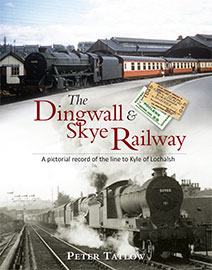
Peter Tatlow - an LMS Society member.
|
ISBN 9 781906 537 46 3 Crecy Publishing Ltd, 2016 The Dingwall and Skye Railway was in 1870 the first line, north of Glasgow, to reach the west coast of Scotland and is still the most northerly. In the first instance it opened only to Stromeferry on Loch Carron. In 1897 it was extended to the Kyle of Lochalsh, opposite the Isle of Skye. At over 63 miles it is the longest branch line in Great Britain. Threatened with closure during the Beaching era, it was reprieved by the traffic generated in connection with the construction of a concrete platform for the off-shore oil industry. Thereafter vigorous campaigning by local government and the community has secured its ongoing operation, thereby continuing to provide one of the most dramatic and picturesque rail journeys in the country. With over sixty years of personal experience of the line, the author describes the difficulties of construction through mountainous terrain and along rocky coasts, the challenges of rival and competitive schemes, and the operation of the line over the years; together with a look at the short branch line to the spa village of Strathpeffer. The impact on the remote scattered communities and the means of access to the Hebrides are explored with the changes over the years. 200 photographs and around fifty drawings and diagrams provide the pictorial aspect of this most magnificent of tourist routes. |
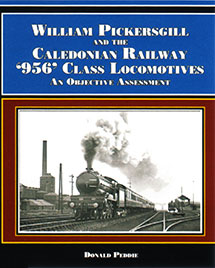
Donald Peddle.
|
ISBN 9 781911 038 05 4 Lightmoor Press 2016. Designed at St Rollox to work, without assistance, the heaviest passenger trains on the company's principal routes of Glasgow to Carlisle and Aberdeen, the '956' Class would be required to haul 425 ton loads, as well as operating at 75-80 mph to maintain the booked timetable. For the class of four locomotives, out-shopped in 1921, three-cylinder propulsion, using a novel 2:1 derived motion for the centre cylinder was chosen, this being associated with a large boiler. Unaccountably, a number of recognised technical imperatives, well established with earlier classes, were neglected. Initial trials results were disappointing, difficulties being found with both the steaming capabilities and with the novel valve gear, which was subject to two major redesigns, with little obvious improvement. |
|
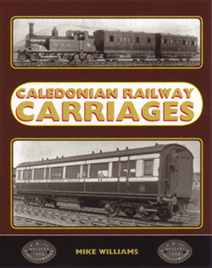
Mike Williams.
|
ISBN 9 789811 038 00 9 Lightmoor Press 2015 360pp The latest title to be published jointly by the Caledonian Railway Association and Lightmoor Press is the long-awaited book which describes the carriages owned and operated by the Caledonian Railway from its opening until the 1923 Grouping. The topics covered include the CR's reaction to technological developments in railway passenger transport and the increasing attention paid to passenger comfort and convenience. The evolution of its carriage livery with challenges some aspects of 'received wisdom.' It also deals with furnishing and internal decor. The classes of stock are covered by reviewing the general service stock to the end of McIntosh's tenure in 1914, the down-rated carriages acquired from the West Coast Joint Stock fleet, the Pullman cars and the final designs in the Pickersgill regime. The CR ambulance train and other carriages in war-time service are described along with vehicles which were not part of general service stock. Saloons, Invalid carriages, Post Office vehicles, the prison van, Inchture horse bus and the Connel Ferry rail motor are all covered along with some proposed designs that never saw service, including a steam rail motor. The book comprises 360 pages of text and illustrations, 275 mm. by 215 mm., printed on gloss art paper with colour laminated printed board covers and is lavishly illustrated with some 250 photographs and over 300 drawings. Appendices give information about the number of carriages in the fleet, carriage orders and building dates and list the available drawings of carriages and components, with their Archive location. |
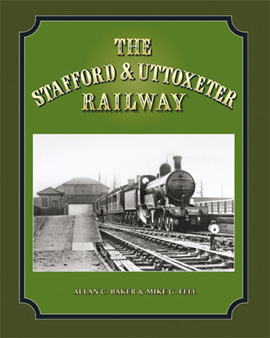
Allan C. Baker & Mike G. Fell.
|
ISBN 9 781899 889 90 7 Lightmoor Press 2015 240pp. The 12½ mile Stafford & Uttoxeter Railway opened in 1867 and had running powers from Bromshall Junction into the North Staffordshire Railway station at Uttoxeter. At the other end of the line the S&UR, with the agreement of the L&NWR, accessed Stafford Station which was also used by NSR trains. The line spent most of its independent life in receivership, eventually being acquired by the enterprising Great Northern Railway in 1881. This book explores how that railway developed its relationship with the NSR over whose line it had to pass in order to reach its own metals at Egginton Junction. At the grouping of the railways in 1923, the GNR became part of the L&NER whereas the NSR and L&NWR became part of the LM&SR and so it was that Stafford and Uttoxeter continued to be locations where the trains and liveries of different railway companies rubbed shoulders. The narrative describes the personalities, operation and traffic of the S&UR, and examines the industries served by the railway, including the extensive salt works located at Stafford Common. The former S&UR lost its passenger service in 1939 but the line survived to become nationalised, the through link finally closing in 1951. The result of extensive and detailed primary research, the book is profusely illustrated and will appeal to railway enthusiasts and those who want to learn more about past commercial and industrial enterprise in the area in which they reside. |
|
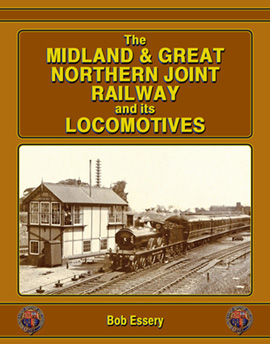
RJ Essery, an LMS Society member.
|
ISBN 9 781899 889 37 2 Lightmoor Press 2015 240pp. The Midland & Great Northern Joint Railway came into being in 1893, when the Eastern & Midlands Railway, having over extended itself financially, was jointly taken over by the Midland and Great Northern railways. The E&MR main line linked the Midlands and the North of England with the popular Norfolk coast resorts and its acquisition enabled these two railways to reach deep in to the heart of Great Eastern Railway territory. Following the joint takeover, the Midland assumed responsibility for the motive power whilst the GN looked after the signalling and permanent way. The line was run by a Joint Committee, the representatives of the MR and GNR giving way to those of the LM&'SR and L&NER after the 1923 Grouping. It was only when the line was ceded to the L&NER in 1936, however, that it began to lose its independent identity, with the locomotive department seeing the M&GN and ex-Midland types replaced by those of the L&NER and constituents. The locomotive history of the Midland Railway has been extensively covered by the author, in conjunction with the late David Jenkinson, in a four volume series published in the 1980s. At that time, it was intended to carry on and cover the locomotive histories of the London, Tilbury & Southend Railway, which came in to Midland hands in 1912, and of the two Joint lines which came under Midland control, the M&GN and the Somerset & Dorset Railway. The former came out in 2000 but the latter two lines still remained to be covered. This detailed profusely illustrated history of the Midland & Great Northern Railway, and in particular its motive power right from the very early days of the companies which grew to form it, therefore fills another important gap in the locomotive history of the Midland Railway. The text includes much new information which has come to light in the last twenty years, adding to the research previously carried out in the 1980s, whilst much of the illustrative content, including numerous detailed plans and a plethora of historic original photographs, has not previously been published. The majority of the M&GN system was closed in 1959 and, today, the only surviving section is that operated as a preserved line by the North Norfolk Railway, who do much to keep the memory of the old company alive. This volume is therefore a timely addition to the history of this most distinctive of railway's, which will be appreciated by enthusiasts, modellers and railway historians alike. |
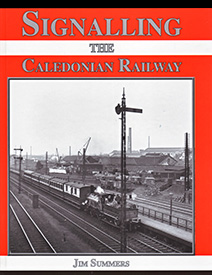
Jim Summers - an LMS Society member.
|
ISBN 9 781899 889 91 4 Lightmoor Press 2015 318pp. The face of the Caledonian Railway was unmistakable, whether in the remote Highlands or the bustling industrial areas of central Scotland. Hitherto, studies of the railway have concentrated on its characteristic locomotives and rolling stock. For the first time, a volume is now devoted to the Caledonian infrastructure, in particular the signals, the telegraph pole routes and the signal boxes, which also distinguished the Caledonian scene. A close look with the sharp eye of the modeller is taken at these and their associated equipment. The signalling system existed to serve the traffic and so this book sets it in this wider context, recording how methods of controlling traffic evolved ingeniously to meet changing needs and discussing the men who devised and maintained it. A valuable chapter explains the organisation, and an explanation of the work of the operating staff is supplemented by John Paton's definitive essay on the architecture of their workplace, the signal box. Its development is charted by an unrivalled collection of photographs. This story of how a great railway tackled safety and capacity is richly illustrated by historic photographs, which serve to throw a new and fascinating light on the Caledonian scene. Adherents of other railways who read this volume will find themselves looking at their own linesides with renewed interest, while admirers of the Caledonian will find much to sustain and enrich their passion. Produced in association with the Caledonian Railway Association. |
|
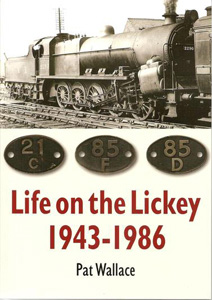
Pat Wallace.
|
ISBN 9 781858 585 23 9 Brewin Books 2014 160pp For over forty years author Pat Wallace worked the Bromsgrove line, well known for the steep Lickey incline and the locomotives which helped the heavy trains to cope, including the famous Big Bertha. From engine cleaner to fireman and driver, Pat carefully records his career in a series of diaries which capture the daily routine and events of a railwayman's life as steam hauled trains gave way to diesels. Today the line awaits a new station and electrification. The book is complete with one hundred photographs of locomotives and rolling stock through the years. |
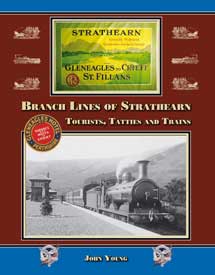
John Young.
|
ISBN 9 781899 889 88 4 Lightmoor Press 2014 296pp. Sir Walter Scott once described Perthshire as 'the most varied and the most beautiful' county in Scotland. Within Perthshire, Strathearn fully merits this accolade, with Upper Strathearn renowned as a tourist destination, and the lower reaches being a rich agricultural area. For over a century, the branch lines of Strathearn were an integral part of this district. This comprehensive history of those lines is the culmination of research over fifty years, drawing on many original documents and contemporary accounts. Lavishly illustrated with nearly 300 photographs, many never previously published, and over 200 other illustrations, it traces the development of these branch lines from the opening of the Crieff Junction Railway in 1856 to the closure of the last section of line in 1967. This book also details the part these railways played in the development of the district and the communities they served, including a chapter on Gleneagles Hotel, all of which will be of interest to the general reader as well as the railway enthusiast. Produced in association with the Caledonian Railway Association. |
|
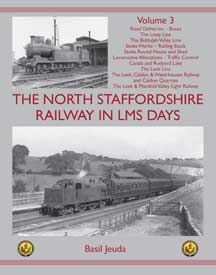
Basil Jeuda.
|
ISBN 9 781899 889 83 9 Lightmoor Press 2014 184pp. The third and final volume looking at what happened to the North Staffordshire Railway after it became a part of the LM&SR in the Railway Grouping of 1923. This was a period of great social, political and economic upheaval, from the General Strike of 1926, to the great depression of the early 1930s and ending with the Second World War. Shortly afterwards, the railways of the United Kingdom were Nationalised, which changed their appearance and the way they were run forever. This third book commences with a short introduction and takes a look at the road delivery operations in the North Staffordshire Section during the LM&SR era, as well as a brief mention of bus services. We then travel around the Loop Line, which is followed by a journey along the Biddulph Valley Line, both trips being interspersed with visits to the collieries and industrial concerns served en route. The next visit is to Stoke Works, to find out what happened to it under LM&SR ownership, after which we take a look at the fate of ex-NSR rolling stock once it had been subsumed into the LM&SR fleet. A detailed study of Stoke Round House and shed is followed by a look at locomotive allocations and use on the NS Section during the period and we then take a brief look at traffic control operations. Another detailed chapter then looks at what happened with the NSR's smaller canals and ends with a short synopsis of Rudyard Lake's fall from grace under the LM&SR. Heading back out on to the rails again, we then travel the Leek Line from Stoke to Leek, from where we go up on to the Leek, Caldon & Waterhouses Branch and to the quarries at Caldon Low, to then finish our study of the LM&SR's North Staffordshire Section with a journey along the narrow gauge Leek & Manifold Valley Light Railway. Lavishly illustrated, with over 500 photographs, maps, tickets, posters, handbills, etc, much of it not previously published. Original research has again provided much new information for the text and captions. Basil Jeuda has written and lectured extensively on the NSR and the area it served for more than thirty years and, together, these three volumes now form an important illustrated history of the North Staffordshire Section of the London, Midland & Scottish Railway. |
Michael Andrews.
|
ISBN 9 780956 97 09 0 9 Barrai Books 2014 256pp. When the Furness Railway became part of the London, Midland & Scottish system in 1923 it was a well known company serving the steelmaking and shipbuilding town and port of Barrow-in-Furness, the industrial and mining belt of West Cumberland and the southern part of the Lake District. Its main line ran from Carnforth on the main West Coast route of the London & North Western Railway to Whitehaven, a distance of 74 miles. It owned the Wennington- Carnforth line jointly with the Midland Railway and the Whitehaven to Moor Row, Rowrah and Marron Junction lines jointly with the LNWR. It operated steamers on Windermere and Coniston lakes and a large dock system at Barrow. In 1922 its capital exceeded £8m. Its origin some 80 years before, was as an isolated single line of 14 route miles promoted by the principal Furness landowners, their associates and agents to bring down to the coast the slate from Kirkby Moor and the hematite iron ore from mines above Dalton, for shipment by sea to the Mersey, the Dee and the Severn. The original capital in 1844 was £100,000. In 1878, after tough negotiations with the LNWR, it obtained jointly with that company, ownership of the Whitehaven, Cleator & Egremont Railway and in 1879 it commenced working the main line traffic of the newly opened Cleator & Workington Junction Railway. The story of the Furness Railway was not one of continuing prosperity as, towards the end of the 19th century, advances in steelmaking technology eliminated the supremacy of hematite iron which had been essential for the pioneering Bessemer steel process. The iron and steel industry of Furness and West Cumberland lurched from financial crisis to financial crisis. Barrow became more and more dependent on the shipbuilding industry founded in 1870 by railway and steelworks proprietors. The FR itself became increasingly expensive to operate as the Board of Trade introduced safer working practices. A second generation of railway managers developed the tourist traffic but profits continued to decline, the 10% dividends of the early 1870's falling to around 3% from the turn of the century. 256 pages casebound fully illustrated with half tone and colour photographs and a range of maps and drawings from archive sources |
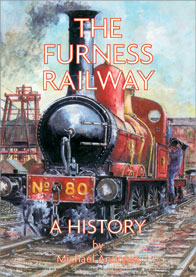
|
Philip Grosse.
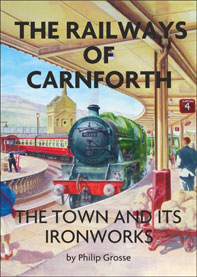
|
ISBN 9 780956 97 09 1 6 Barrai Books 2014 180pp. This is a special edition publication to commemorate the tenth anniversary of the opening of the Carnforth Station Heritage Centre in 2003. This book provides a comprehensive history of the railways of Carnforth from the earliest days of railway development to the present day. Carnforth grew from a wayside halt on the L&C Railway into an important junction on the London to Glasgow main line with main lines to Leeds and Barrow in Furness. Carnforth's role as an important railway centre ended with the closure of the motive power depot and the exchange siding in 1969 and the removal of the mainline platforms in 1970, it eventually became an open station in 1988. From 1860 Carnforth gradually became a significant railway town which rapidly expanded to house the three railway companies' workers. For nearly seventy years the Carnforth Haematite Iron Company produced high grade pig iron until it closed in 1929. It built an industrial village in the parish of Warton to house its workers. Parts of the classic film "Brief Encounter" were taken on the station during war time blackout and its connection to the film has enabled the derelict station to be regenerated as the Carnforth Station Heritage Centre. The author has carefully researched and brought together a fascinating account of the railways, the township, and the ironworks and the making of the film at the station and in doing so drawn upon a wide range of material much of which has not previously been published. Fully illustrated with maps and drawings from archive sources together with half tone and colour photographs from the Cumbrian Railways Association, Rathbone and other individuals collections. |
Peter Tatlow, an LMS Society member.
|
ISBN 9 781909 328 13 6 Noodle Books 2014 200pp plus index. Highland Railway Carriages and Wagons is a totally new book and the first time the rolling stock of the HR has been subject to such close scrutiny. Written by the renowned Peter Tatlow and produced in conjuction with the Highland Railway Society, this is a work that will appeal to all with an interest in rolling stock - probably regardless of company or period. 200 sides, heavily illustrated with copious drawings at 4mm to the foot make it a book that will be cherished. Casebound, 200 pages with full indexing. Printed on heavy art paper. |
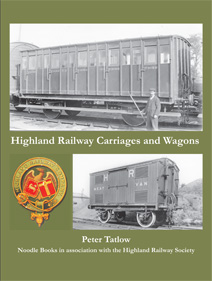
|
Peter Darley.
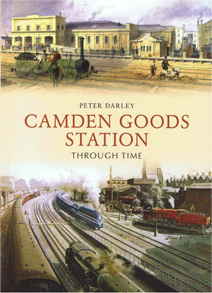
|
ISBN 9 781445 622 04 0 Camden Railway Heritage Trust 2014. The London & Birmingham Railway was the major project of its day, designed by Robert Stephenson, one of the great railway pioneers, who also supervised its construction and its opening in 1837. Camden Goods Station became the goods terminus and Euston Station the passenger terminus. For a few years trains were hauled by rope from Euston up the incline to Camden before the intensification of both passenger and goods services rendered such technology obsolete. The L&BR left a strong footprint on the landscape from Euston to Camden Town and Primrose Hill. The story moves from rapid economic growth to eventual decline and then to the recent regeneration. The historic features around the former Goods station are providing the basis of Camden's transformation through its markets, media, music, food and entertainment into a global brand. Join Peter Darley in unfolding this story from 1837 to the present day. A fascinating selection of 200 images, photographs and drawings, published in February 2014, illustrating how some of London's most significant industrial heritage sites have changed in the course of almost two centuries. Peter Darley is a leading figure in the Camden Railway Heritage Trust. He is a chartered engineer and lives in Primrose Hill. He conducts guided tours and gives talks on the area's industrial heritage. Available from the Trust for £12.00 including postage. Payment by cheque to Peter
Darley, 21 Oppidans Road, NW3 3AG or email [email protected] regarding direct bank transfer
|
RJ Essery, an LMS Society member, and P Davis.
|
ISBN 9 781908 763 03 7 Wild Swan Publications 2013 160pp. The question of what the LMS inherited from the constituent and subsidiary companies has often been considered in regular planning meetings for the LMS Journal. As far as we could see, the subject is not one to have commanded much attention from other authors and begs the question, what did the LMS inherit, how good was it and how long did it last before the new company replaced these assets? This question could be directed to a variety of subjects ranging from fixed structures,signalling, livery, locomotives and rolling stock and even company identity, but we have chosen to begin our investigation with the largest constituent company of the LMS, the London & North Western Railway and to deal with its stock of locomotives. Self styled 'The Premier Line', it was formed in 1846 by the amalgamation of the London & Birmingham, Grand junction (an 1845 amalgamation of itself with the Liverpool & Manchester and several minor Lancashire companies) and Manchester & Birmingham Railways. When considering the L&NWR prior to the 1923 grouping, we must also consider the North London Railway, a line that was incorporated by an Act of 26th August 1846 as the East and West India Docks and Birmingham Junction Railway. In December 1908, an agreement to last twenty-one years was entered into between the North London and London & North Western Railway Companies to the effect that the North London would continue to exist as a separate corporation, but their senior officers would be retired and their places taken by the corresponding officers from the L&NWR. There was also the Lancashire & Yorkshire Railway Company, the origins of which lay in a number of small lines that came together in 1847 assuming the title Lancashire &; Yorkshire Railway. Terms for amalgamation were agreed between the L&NW and L&Y in December 1921 and from 1st January 1922 the combined system was operated as one railway. For the purpose of this work, the locomotives of the Lancashire & Yorkshire Railway are excluded, but the locomotive stock of the North London Railway are included. Although it is not possible or even desirable to ignore the pre-1923 history, it is not intended to delve into the various aspects of LNWR locomotive history so beloved by some writers. The question of the suitability of Webb's designs, in particular his compounds, will not form part of this work; indeed the publisher and I take the view that the LMS inherited all manner of mechanical items from the constituent and subsidiary companies and, that the quality varied, but they became LMS stock, and the purpose of these books is to record, as objectively as possible, what it was and how it fared during the years that followed. Therefore, in many respects, this is a 'broad brush' approach and no attempt has been made to include every minor detail that affected every class of locomotives. Nevertheless, this illustrated survey has taken many pages, so we have divided it into three manageable volumes, the first covering passenger tender classes, the second the tank engine classes, and the third the goods tender engines. The information in this work has been compiled from a number of sources, the majority of them secondary, and when crosschecking it became clear that not all the dates and facts quoted were identical. While every effort has been made to crosscheck them, the lack of prime source material means that information given may be at variance with other published works on the subject. There are many ways of interpreting historical fact and we hope this work will be seen as accurate and comprehensive and add to our knowledge of the story of LNWR locomotives during the post-1923 period. The final point is addressed to those readers who are also railway modellers. Experience as editor and publisher of both LMS Journal and Midland Record has shown us that many readers use these titles as a source of reference and information for modelling projects, so accurate detail information is important to them, therefore we will try to be mindful of their needs. |
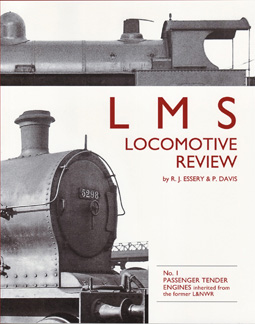
|
David Ross.
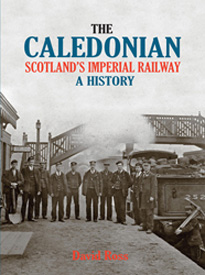
|
ISBN 9 781840 335 84 2 Stenlake 2013 252pp. The publishers believe this will become the definitive book about this famous railway and its history. It is the first full history of the Caledonian Railway ever to be published. Based on original source documents and contemporary newspapers and journals and fully referenced, it traces its development, through troubles both legal and commercial, as an operating railway and a business with its own distinctive style Profusely illustrated, it is an essential book not only for those with an interest in the old railway companies and their often tumultuous relationships with each other, but for the light it sheds on Scottish society and commerce during the long high noon of industrialisation and growth. This is a sumptuous, beautifully illustrated, hardbound volume stuffed with facts and information no railway enthusiast can afford to be without. Charting, as it does, the impact a single transport endeavour can have on the communities through which it passes and the industry which springs up in its wake, it is also of major interest to historians, archaeologists, sociologists and anyone who finds the industrial heritage of the British Isles of interest. The book is also a work of art in itself. |
Mike Williams.
|
ISBN 9 781899 889 74 7 Lightmoor Press 2013 320pp. This is the first detailed history of the Caledonian Railway's wagons, from the opening of its first line in 1847 until the Company became a part of the LM&SR at Grouping in 1923. The research is based on Board minutes and other official sources, whilst over 250 official drawings have been examined. The introduction details the sources of information used and a chapter on the industrial development of Scotland outlines its influence on the size and diversity of the wagon fleet. The types of wagons and numbers in service are tabulated and the financial pressures which hamstrung the modernisation programme begun in the early 1900s are also described. An overview is offered of technical developments, which discusses how two Locomotive Superintendents transformed the wagon fleet. The liveries of wagons and Non-Passenger Coaching Stock are next described, supplemented in each case by the systems used by the Caledonian to allocate running numbers. Photographic evidence and drawings depict a far more complex picture than that presented previously. Eleven chapters then deal with different types of wagons, ranging from those built by the thousand, to small numbers of wagons for special traffic. Building dates are given for each design, whilst design developments are described and supported by photographs and works drawings. Sample running numbers are included for modellers. A further chapter describes the Caledonian's relationship with the private traders who ran wagons over the system. Appendices list the construction orders undertaken by the company and outside contractors. The surviving works drawings are listed, with their archive references, and the photographs in an official album dating from 1900 are described. A final appendix gives information about drawings for the modeller, supported by specially commissioned drawings of details characteristic of Caledonian wagons. Produced in association with the Caledonian Railway Association. |
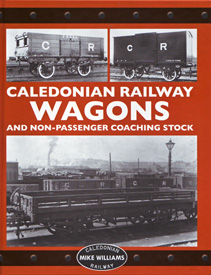
|
Basil Jeuda.
|
ISBN 9 781899 889 65 5 Lightmoor Press 2012 176pp. The second of three volumes looking at what happened to the North Staffordshire Railway after it became a part of the LM&SR in the Railway Grouping of 1923. This was a period of great social, political and economic change and turmoil, which climaxed with the Second World War. Shortly afterwards, the railways of the United Kingdom were Nationalised, which changed their appearance and the way they were run forever. This second volume begins with a short introduction, which includes essays on the decline in milk traffic and the promotion of Workmen's tickets in North Staffordshire. We then take a brief look at ex-NSR locomotives in Crewe Works, before journeying from there to Harecastle, followed by trips along the Sandbach Branch and the little known Macclesfield, Marple & Bollington Railway. This is followed by a lengthy sojourn along the picturesque valley of the River Churnet, after which we return part way up the line to Rocester, to head off along the Ashbourne Branch and ultimately all the way to Buxton. Another long journey is then undertaken from Stoke to Derby, before returning a short way back to Tutbury to take the branch to Burton. Along all of these routes, brief stops are made to examine various industries and other aspects in more detail, such as the gypsum mines at Fauld, the Royal Ordnance Factory at Radway Green, minor branch lines such as that to Cheadle, or the various ex-NSR engine sheds encountered. This volume ends with a brief study of the operations of Railway Air Services Ltd, particularly in relation to Meir aerodrome at Stoke. The volume is again profusely illustrated, with nearly 500 photographs, maps, tickets, posters, handbills, timetables and other material, much of it not previously published. Further original research has once more provided much new information for the text and captions. Basil Jeuda has written and lectured extensively on the NSR and the subsequent history of the area it covered for more than thirty years, and this seminal work is building into an important illustrated history of the North Staffordshire Section of the London, Midland & Scottish Railway. |
Mike Arlett & David Lockett.
|
ISBN 9 781899 889 31 0 Lightmoor Press 2012 192pp. Norman Lockett began taking black & white photographs in the 1930s, using glass plate negatives, a medium he preferred until the end of steam. A modest man, the vast majority of his output has never been published, despite its superb quality. Here, in the first volume of a series which will feature the pick of his work, we present over 200 highly evocative photographs of one of the best loved and most picturesque railway lines with which this country was once blessed - the S&D. Whilst Norman had his favourite 'spots' - such as the Midford Valley and Winsor Hill - he captured some of the lesser known parts, around Highbridge and the Bridgwater Branch, as well. He also looked for viewpoints not appreciated by others. In order to present Norman's work at its best, the publishers have returned to the original glass plates for the scanning process, rather than use his prints. This has revealed much extraneous detail which had been either lost in the printing process or simply cropped out altogether. Devotees of railway photography, S&D enthusiasts, railway historians and railway modellers will all find much to enjoy and of interest within these pages, with Norman's pictures being accompanied by a lively and knowledgeable text and captions, written by well known S&D authority Mike Arlett. There can be few railway photograph collections of this quality still largely unpublished, so this is a rare chance to appreciate the work of a largely 'unknown master'. Produced in association with the Caledonian Railway Association. |
|
Basil Jeuda.
|
|
ISBN 9 781899 889 48 3 Lightmoor Press 2012 160pp. The first of three volumes looking at what happened to the North Staffordshire Railway after it was taken over by the LM&SR in 1923, up until 1947 when the LM&&SR was Nationalized. During this period, the country suffered the economic downturn of 1924 and a slump that lasted from 1929 until the late 1930s, which was then followed by the Second World War and its aftermath. This first volume covers the background to the establishment of the LM&SR and the demise of the NSR, the changing nature of industrial activity in North Staffordshire, the competition with road transport for passenger and freight traffic, and the impact of the Second World War. Separate chapters then follow the main line from Manchester and Macclesfield through Stoke to Colwich, including the Talke and Chesterton branches, connections to the factories of Michelin Tyres and Josiah Wedgwood, the Trentham Park Branch and ROF 5 Cold Meece. There is an introduction to the NSR canal system, which then goes on to follow the whole of the Trent & Mersey Canal, and there is a short section on the hotels of the NSR. This volume then concludes with a journey along the Stoke to Market Drayton line, which also includes diversions off on the Pool Dam and Apedale branches, the Newcastle-under-Lyme Canal, and the Audley Branch. The book is profusely illustrated with over 400 pictures and several maps, whilst the author has also had access to many previously unpublished items of ephemera, including timetables, tickets and other material. The considerable text benefits from extensive research, that has yielded much new information. Basil Jeuda has written and lectured extensively on the NSR and the subsequent history of the area it covered for more than thirty years, and this is the first major work to be published on the North Staffordshire Section of the London, Midland & Scottish Railway. |
T. B. Maund.
|
ISBN 9 781899 889 38 9 Lightmoor Press 2012 240pp. The Wirral peninsula, which forms the top north west corner of Cheshire and sits between the rivers Dee and Mersey, is almost an island and, in many respects, exhibits the characteristics of a region isolated from other influences. This was undoubtedly even more pronounced in times gone past and is a feature that was particularly well illustrated in the development and 'look' of the railway company which served the most northerly and populated part of the peninsula - the Wirral Railway. The railway itself began in splendid isolation, with a branch from Birkenhead Docks to Hoylake, opened in 1866. From impecunious beginnings - the company was in receivership by the late 1860s and services ran only between Hoylake and Leasowe until 1872 - the Wirral system grew to become a busy commuter railway for the many people travelling over the Mersey to Liverpool, its tentacles eventually extending to West Kirby, New Brighton and Seacombe. Today, with the exception of the Seacombe Branch, the line remains in service as part of Merseyrail, carrying out the job it has always done. This is the first comprehensive study of the railway's origins and its history as the Wirral Railway, followed by its later years under the LM&SR and British Railways, its operations, stations, locomotives, shed and works, and rolling stock. Its small locomotive fleet comprised entirely of tank engines and its independent nature is reflected in the fact that it was the first railway company in mainland Great Britain to run engines of the unusual 4-4-4 wheel arrangement. The goods traffic using the Wirral Railway is also studied in detail, including the industries, private sidings and wagons which connected to the system. Of particular note here is the highly lucrative working arrangement with the Great Central Railway, which allowed GC traffic to pass the short distance over Wirral metals from Bidston to Birkenhead Docks and which for many years generated a significant portion of the Company's profits. Wirral residents, both past and present, will obviously find much to enjoy here, whilst students of railway history will delight in delving into the machinations of one of the lesser lights of the British railway scene. Modellers, too, will find much to inspire them. T.B. Maund has compiled what will now become the definitive history of the busy, independent minded Wirral Railway. |
|
The Late Geoff. Holt.
|
ISBN 9 781908 763 05 1 Wild Swan Publications Ltd. 2013 136pp in full colour. In view of Geoff's failing health, Wild Swan pulled out all the stops to publish this book as soon as possible but very sadly Geoff passed away before he saw the book. He was one of the country's finest loco modellers and this book, together with Volume One, will stand as a memorial to his outstanding talent. |
Geoff. Holt, an LMS Society member.
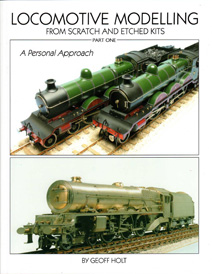
|
ISBN 9 781908 763 01 3 Wild Swan Publications Ltd. 2012 107pp in full colour. A very user friendly, straightforward and encouraging book in which the author guides the reader through the techniques necesary for loco building, covering the two disciplines of kit- and scratch-building. As he doesn't feel there has been any appreciable difference in his approach from modelling in 4mm to 7mm and 10mm scales, the book should prove useful to everyone, but 7mm is the focus throughout these pages. Ingeniously, Geoff has supported his text with a pair of signature rnodels whereby he tackles two engines of the same class, one scratchbuilt and the other kitbuilt, in order that the differing processes can be seen in direct comparison. |
L. G. Warburton, an LMS Society member.
|
ISBN 9 781906 419 95 0 Noodle Books 2012 184pp plus index. WARTIME LMS takes the story of the company from the build up and preparation to WW2, through the days of conflict and back to the difficult times that followed. This is a learned tome, well illustrated of course, but one where the text carries the true story of each department of the railway including the men in charge of each, and how they prepared for and dealt with the running of the railway during the period. Illustrated with contemporary material including fold out maps contained within a pocket at the rear. |
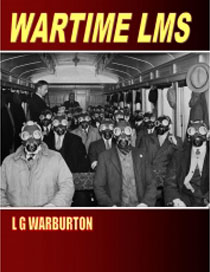
|
Edward Talbot.
|
ISBN 9 780954 278 75 5 Edward Talbot 2011 104pp. The streamlined Pacifics of the London Midland & Scottish Railway were amongst the most outstanding of all British steam locomotives. Their style and design captured the imagination and set them apart from everyday engines. In the public mind they ranked equally with the streamlined 'A4' class of the London & North Eastern Railway, and when one was displayed at the New York World's Fair in 1939, they became famous all over the world, as one of a small number of elite streamlined designs along with the New York Central Rail Road's 'J3a' class Hudsons, and the Milwaukee Road's 'Hiawatha' Atlantics and Hudsons in the USA. This new book is a celebration in photographs of these magnificent machines and will give pleasure to all their many admirers. It contains 96 pages with 160 black and white photographs, and 8 pages of colour, featuring superb paintings by Gerald Broom, Tom Connell and Barry G. Price. It is a companion volume to The Coronation Scot, the Streamlined Era on the LMS, published in 2002, which described the train, the locomotives and the carriages, and the whole venture of the LMS into streamlining. |
Peter Tatlow, an LMS Society member.
|
ISBN 9 781906 419 69 1 Noodle Books 2012 256pp. There are few railways subjects that have not been the subject of any number of books - but Breakdown Cranes is certainly one. Renowned railway writer Peter Tatlow has spend several decades researching the history, origins, allocations, and work of these marvels of the mechanical age. Part 1 in the series takes the story of the steam crane through from its earliest days to the start of the 'long-jib' variant, although many of the examples featured in this book were still active into the 1970s. Illustrated in both b/w and colour complete with numerous drawings. |
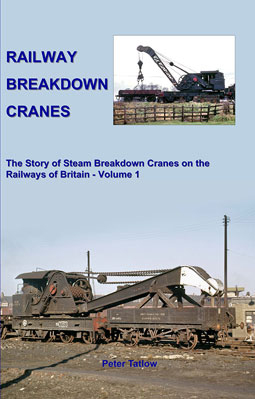
|
Peter Tatlow, an LMS Society member.
|
ISBN 9 781910 809 92 1 Noodle Books 2013 272pp. Railway Cranes Volume 2 details the larger breakdown cranes of 36 tons capacity and above that were used by various railway companies as well as British Railways. Also included are cranes operated by the Ministry of Supply. As with the other two volumes in this series, Peter Tatlow, a now retired professional engineer, describes the types of cranes covered in great detail supplemented by his expert scale drawings. Information contained within includes the make up the cranes, their technical details, weights, sizes and other relevant information and just as importantly, many illustrations of cranes at work in a variety of situations. Illustrated in both b/w and colour complete with numerous drawings. |
|
Peter Tatlow, an LMS Society member.
|
ISBN 9 780860 936 84 8 Noodle Books 2018 256pp. Peter Tatlow's background as a professional engineer leant considerable weight to his two previously published volumes on Railway Breakdown Cranes both of which have received unqualified praise from reviewers. This new book looks at the smaller cranes used by the engineers and other departments mostly on track work though sometimes they operated at stations on other duties. These smaller cranes, which were mostly self-propelled, were powered by either by steam or diesel though in order to present a complete picture of this range of specialist vehicles, some hand cranes are included. In series with the two earlier volumes, the book's detailed text is accompanied by numerous colour and monochrome illustrations and the author's meticulous drawings are reproduced to 4mm scale making them ideal for the modeller. The narrative transcends BR regional and railway company boundaries and records the history of these smaller cranes from the earliest days right up to the present. Like the two previous Railway Breakdown Cranes volumes, this new book covers a subject never before tackled and so will be welcomed by railway enthusiasts, historians and modellers. Illustrated in both b/w and colour complete with numerous drawings. |
|
H. J. Campbell Cornwell.
|
ISBN 9 781899 889 56 3 Lightmoor Press 2011 192pp. This is a detailed study of the Caledonian Railway's 'Jumbo' 0-6-0s, officially the '18in x 26in x 5ft 0in Goods Engine', which were not only the workhorses of the Company but also formed the largest class of locomotives in Scotland. The 244 members of the class were built over a fourteen year period between 1883 and 1897, and many were also Westinghouse braked, whilst some were vacuum fitted as well, which thus allowed their extensive use on passenger traffic too. With the aid of official plans and drawings, along with numerous mostly previously unpublished photographs, and in conjunction with technical specifications and other data, the author has faithfully documented the history, work, performance and allocations of these iconic little engines for posterity. The entire class was taken over by the LM&SR at Grouping and most of them survived into the BR era, with the last four only being withdrawn in 1963, giving the 'Jumbo's a history of 80 years in total. The book comprises 192 pages, 8 in colour, 275 mm. by 215 mm., printed on gloss art paper with colour laminated printed board covers and is lavishly illustrated with over 150 colour and B&W photographs covering the full life history of the class. The 50 plus official drawings and diagrams will prove invaluable to both modellers and historians and the many tables of analysis covering work and performance will allow many aspects to be studied in depth by the reader. The Appendices include the full specification supplied to Neilson for their Works Order E561 and T56l, and individual engine histories, as extracted from the record cards, along with a full bibliography. Published in conjunction with the Caledonian Railway Association. |
Terry Jenkins.
|
ISBN 9 780901 461 58 2 The Railway & Canal Historical Society 2011 272pp. Ernest John Hutchings Lemon rose from the humblest beginnings to become a Vice-President of the LMS Railway. He was born in 1874, the son of a labourer in an obscure Dorset village, and a fortunate set of circumstances led to his apprenticeship at the North British Locomotive Company in Glasgow. In 1914 he joined the Midland Railway as Chief Wagon Inspector, soon rising to become Works Manager at Derby in the Carriage & Wagon Department. In association with 'Bob' Reid, he revolutionised the way wagons, and later carriages, were constructed, by introducing assembly-line techniques. Further promotions followed after 'grouping' in 1923, and in 1931 he was appointed Chief Mechanical Engineer of the LMS Railway - a post he held for less than a year before his appointment as Vice-President in 1932. Throughout the 1930s he continued to overhaul the way the railway worked, seeking to eliminate old and inefficient practices. Lemon was one of the first proponents in this country of 'Scientific Management', a business philosophy first developed in the USA, and he introduced the principles to all phases of railway working and management. In the summer of 1938, Lemon was seconded to the Air Ministry, as Director-General of Production, when the Government finally reacted to the charges of incompetence in the re-armament of the RAF. The programme had been dogged by controversy, monetary restrictions and delays, and the defence of this country still rested largely on obsolete aircraft. Production of the much-vaunted new generation of fighters had stagnated and was months behind schedule. The aggressive behaviour of Germany lent an even greater urgency to the situation, and Lemon was charged with the task of expediting and reorganising production. His reforms successfully enabled the programme to be completed ahead of schedule, and it was for this work that he was knighted. When this country had to face the full might of German air attacks in the summer of 1940, the RAF was ready. The Battle of Britain was a close-fought affair, but the RAF did have sufficient aircraft - just! The story of the war in the air has been told in innumerable books. What is not so well-known is how the aircraft were produced in the quantities required - and the dynamism and urgency brought to the project by one man. This book is the story of his life, both professional and private. The author has been fortunate to have had access to Lemon's own personal papers, and these - together with hitherto unknown archives discovered during research - shed new light on the management of the LMS at the time. This is especially true of the circumstances surrounding both Lemon's, and then Stanier's, appointments as CME and the importance of Sir Harold Hartley in the affair, which will cause many long-held views to be reassessed. 'The London Midland and Scottish Railway was one of the most important companies in Britain from its creation in 1923 to nationalisation in 1947. Lord Stamp, the President, is rightly cited as a key player in British business, but he was supported by very able managers. Ernest Lemon was one of the most capable engineer/managers of his generation, as evidenced by his role in the LMS as Vice-President; and, later, in the Air Ministry as Director-General of Production supporting Sir Wilfrid Freeman. This biography of Lemon is an important contribution to business and political history and tells the story of Lemon's career in both railways and aviation. It sheds light on an important player in British engineering, using important new archival material, to reveal a complex personality and the very human face of business and policy.' - Dr Roy Edwards, Southampton University School of Management, 2011 |
|
J. Kernahan.
|
ISBN 9 781899 889 52 5 Lightmoor Press 2011 160pp. The Cathcart Railway was opened in 1886, before most of the homes it now serves were built. With a length of eight miles from Glasgow Central to Glasgow Central, it was operated by the Caledonian Railway from opening until grouping. Jack Kernahan provides a history of the line from the first plans until the present day, including motive power and rolling stock, electrification, track layout and signalling, and the role of the line in popular folklore. The text has been thoroughly updated for this second edition, with additional appendices, photographs and plans. The book comprises 160 pages. 275x215mm. Printed on gloss art paper, casebound with printed board covers. Published in conjunction with the Caledonian Railway Association. |
Barry C. Lane.
|
ISBN 9 781899 816 17 0 7 Pendragon Publishing 2010 182pp, 70 line drawings, 283 b/w and 13 colour photos. Hardback While not being one of the major main lines in the country and never gaining a foothold in the capital, the
Lancashire & Yorkshire Railway led the way with many developments in the design and construction of
locomotives. Indeed, its final CME went on to occupy the same position in the LMS and the influences continued
through to the standard steam locomotives of British Railways. The book catalogues the classes of all steam
locomotives built at the railway's own works at Horwich and includes those bought in from manufacturers before
1889. |
|
L. G. Warburton, an LMS Society Member.
|
ISBN 9 781906 419 41 7 Noddle Books 2010 58pp. Softback First published in 1972, this reference work on L.M.S. Signals is still held in high regard by all railway historians today and remains the definitive book on the subject. Up to that time, few books of this type had ever been produced, yet it set the scene for what would become the now expected detailed work on specific examples of railway history. Only 800 copies of the original book were produced and it has never been reprinted before. Those few copies that do come on the market today command a high price, not just because of rarity value, but because of the expertise clearly demonstrated in its compilation. 38 years later, and long overdue, this is the very first paperback reprint of the original edition. With only a few minor corrections, the book remains 99% as per the original. It will be welcomed by those with an interest in signalling as well as anyone who appreciated a comprehensive and detailed railway work. As per the original, it also contains a section on LMS Signal Boxes by the late V. R. Anderson who was also a Member of the LMS Society. |
R. J. Essery, ex-LMS Society President.
|
ISBN 9 781906 419 33 2 7 Noddle Books 2010 180pp, 174 line drawings, 349 b/w photos. Softback The name Bob Essery will be familiar to nearly all railway enthusiasts and certainly anyone with an interest in either the LMS or rolling stock in general. Amongst the many classic works he has compiled is the popular series on LMS Wagons. First published in the 1980s and unavailable for some time, this new reprint is certain to take the market by storm. The book remains completely unchanged from the original; it comprises 188 pages on art paper with many hundreds of photographs and drawings examining this important subject. The depth and quality of the information included makes this one book no serious railway enthusiast will want to miss out on! |
|
Antony M Ford.
|
ISBN 9 781906 419 22 6 Noddle Books 2010 200pp inc. 24 page colour section. For the second book in the 'Pullman Profile' series, Antony Ford takes as his theme the 'K-Type' Cars built in the 1920s. (Excluding the 'all-steel'veheicles.) In this new volume Each inidividual car is described, its history, renamings (and there were often several) and demise are all examined in detail. Interior and exterior views of numerous cars compliment a readable text split into individual chapters dealing with the varius batches of vehicles built, in the main, by just two specific manufacturers. Tabular information and a section on the works at Preston Park are included. 200 pages on high quality art paper, casebound - landscape format, with copious illustations and plans. |
R. J. Essery, ex-LMS Society President.
|
ISBN 9 781899 889 37 2 Lightmoor Press 2009 192pp. The Midland & Great Northern Joint Railway came into being in 1893, when the Eastern & Midlands Railway, having over extended itself financially, was jointly taken over by the Midland and Great Northern railways. The E&MR main line linked the Midlands and the North of England with the popular Norfolk coast resorts and its acquisition enabled these two railways to reach deep in to the heart of Great Eastern Railway territory. Following the joint takeover, the Midland assumed responsibility for the motive power whilst the GN looked after the signalling and permanent way. The line was run by a Joint Committee, the representatives of the MR and GNR giving way to those of the LM&SR and L&NER after the 1923 Grouping. It was only when the line was ceded to the L&NER in 1936, however, that it began to lose its independent identity, with the locomotive department seeing the M&GN and ex-Midland types replaced by those of the L&NER and constituents. The locomotive history of the Midland Railway has been extensively covered by the author, in conjunction with the late David Jenkinson, in a four volume series published in the 1980s. At that time, it was intended to carry on and cover the locomotive histories of the London, Tilbury & Southend Railway, which came in to Midland hands in 1912, and of the two Joint lines which came under Midland control, the M&GN and the Somerset & Dorset Railway. The former came out in 2000 but the latter two lines still remained to be covered. This detailed profusely illustrated history of the Midland & Great Northern Railway, and in particular its motive power right from the very early days of the companies which grew to form it, therefore fills another important gap in the locomotive history of the Midland Railway. The text includes much new information which has come to light in the last twenty years, adding to the research previously carried out in the 1980s, whilst much of the illustrative content, including numerous detailed plans and a plethora of historic original photographs, has not previously been published. The majority of the M&GN system was closed in 1959 and, today, the only surviving section is that operated as a preserved line by the North Norfolk Railway, who do much to keep the memory of the old company alive. This volume is therefore a timely addition to the history of this most distinctive of railway's, which will be appreciated by enthusiasts, modellers and railway historians alike. The book comprises 192 pages. 275x215mm. Printed on gloss art paper with colour laminated board covers. |
|
Basil Jeuda.
|
ISBN 9 781899 889 01 3 Lightmoor Press 2009 128pp. A comprehensive photographic album of the North Staffordshire Railway with many previously unseen images and captions compiled by one of the recognised experts on the company. Sections on the locomotives, rolling stock, stations, canals, collieries, staff, signal boxes and other structures, provide a good overall picture of the NSR system. |
|
V.R. Anderson & H.N. Twells, both LMS Society Members.
|
ISBN 9 781905 184 63 7 Wild Swan Publications 2009 104pp An LMS Journal Handbook This second look at the LMS lineside contains the following sections:
Packed with illustrations this survey should prove invaluable to modellers. |
Adrian Tester, an LMS Society Member.
|
Published by the author 2008 102pp Spiral bound with numerous diagrams and tables, including one separate fold-out diagram. Paper covers. In the complex field of valves and valve gears, one of the less discussed areas is that of short or long-lap valves. In Britain, the Midland Railway's engineers had used short-lap valves, and were regarded as incompetent by no less an authority than the late E.S. Cox for adhering to them. But Cox and others within the LMS/Crewe establishment were long-lap valve men and used them. In this interesting and technical review of LMS practice, Adrian Tester comes to some interesting conclusions on the subject. |
|
Bob Essery with contributions from John Edgington, both LMS Society members.
|
Part One - LMS Western Division Lines ISBN 978 1 905184 50 7 Wild Swan Publications 2008 144pp |
|
Part Two - LMS Midland Division. Former Birmingham & Derby Junction Railway and later lines connecting to it ISBN 978 1 905184 51 4 Wild Swan Publications 2008 112pp |
|
Part Three - LMS Midland Division. Former Birmingham & Gloucester Railway and later lines connecting to it ISBN 978 1 905184 52 1 Wild Swan Publications 2008 112pp |
The idea for these books emerged when the number and quality of pictures taken by D.J.Norton between 1947-1965 became apparent. However, it soon became clear that we could not confine the work to a single book so we have presented the story in three parts as a celebration of the work of D.J.Norton using pictures taken between 1947-1962 in the Midlands area centred upon his home city of Birmingham. I am delighted to have been able to edit the story and to acknowledge the considerable assistance I received from John Edgington who said, its only right this book should be put together by a couple of Brummies, although neither of us now live in Birmingham, whose motto is, once a Brummie always a Brummie.
Biographical Note.
D.J.Norton - Dennis John Norton - was born in Birmingham in March 1930. He developed an interest in railways early in his life and started photographing locos, stations and lines at the age of 17, just as British Railways were taking over from the 'Big Four'. His interest continued right up to his premature death as the result of an asthma attack in August 1965. Throughout this time his camera was primarily pointed at subjects related to the LMS Company. He held a lineside pass but his concept of 'lineside' seems at odds with what the authorities intended. Standing in the middle of main lines, walking through tunnels and even climbing signal posts were frequent activities. The result of all this disobedience is a collection of photographs containing many unique and unusual views.
He was a friend of many railwaymen, especially those working in signal boxes, places his wife recalls being taken whilst courting. Clearly he was recording the railway system for posterity.
Bob Essery.
Peter Robinson, an LMS Society Member.
|
ISBN 978 0 9540232 6 3 Cumbrian Railways Association 2008 48pp Cumbrian Railways Association publishes a Roll of Honour in remembrance of those who gave their lives in the service of their country during the Great War 1914-1918 The Cumbrian Railways Association has published a Roll of Honour to commemorate the railwaymen from Cumbria who gave their lives in the Great War between 1914 and 1918. Extensive research from war memorials, original documents, local newspapers and websites has revealed the names and service details of 234 men who died in the service of their country, mostly serving in the Army on the Western Front in France and Belgium, and others in many other parts of the world. The men are listed under the names of the twelve railway companies which operated in Cumbria at that time. The Roll of Honour also reproduces moving reports from local newspapers of the Memorial Service to railwaymen held in Carlisle Cathedral in May 1919, and of the unveiling of railway company war memorials at Barrow-in-Furness and Maryport. Illustrated with contemporary and recent images and photographs, the Roll of Honour has been researched by the President of the Cumbrian Railways Association, Peter Robinson. The Roll of Honour has been produced to mark the 90th anniversary of the Armistice which ended the great conflict of the First World War. Available from selected local outlets (cost £5), or by post from CRA Publications, 19 Windsor Drive, Miskin, Pontyclun CF22 8SH (add £1 for post and packing). |
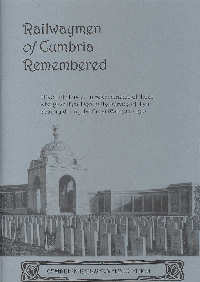
|
Antony M Ford.
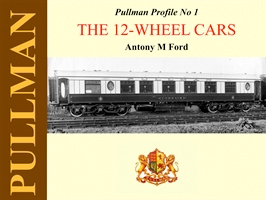
|
ISBN 9 781906 419 00 4 Noddle Books 2008 192pp inc. 16 page colour section In this lavishly illustrated book, No. 1 in a series, here for the first time is the full record of the luxury British 12 Wheel Pullman cars (built between 1908-1923) which graced such celebrated pre-war trains as the 'Southern Belle' 'Harrogate Pullman' and 'Eastern Belle', and post-war the 'Bournemouth Belle' and Ocean Liner express. "PULLMAN PROFILE NO. 1 The 12-WHEEL CARS" presents a fascinating, comprehensive and nostalgic record to the reader and captures an era when the familiar umber and cream Pullman cars flourished at a time when quality really did matter. Nowadays, the Pullman Car Co is an enterprise that continues to attract a widespread following, not only from railway enthusiasts but also from those with a more general interest in by-gone luxury travel. This is scarcely surprising as Pullman was synonymous for superior accommodation and a high level of service. Pullman recognised and appreciated the value of publicity - the inauguration of new services or even new vehicles provided them with opportunities to impress the media of the day. In these and other respects Pullman was unrivalled, yet in other ways it was conservative and restrained. The 12 wheels cars introduced by the Caledonian Railway in 1914 and run under contract by Pullman on the LMS until 1934 (at which time they were incorporated into the LMS fleet of dining cars) are covered in some detail. |
Authors and/or publishers of other LMS related books are welcome to forward details of such via the Hon. Secretary for publication on this page. . A copy (preferably a scan) of the dust jacket/front cover and the blurb would be appreciated.
Site contents Copyright © LMS Society, 2024
April 26th, 2024
Site contents Copyright © LMS Society, 2024